


Non-QM Loans for Real Estate Investors
JCREIG Capital Funding offers real estate investors access to alternative financing solutions designed to simplify the mortgage process. Our No-QM loan programs may be available nationwide, subject to property eligibility, borrower qualifications, and program guidelines.
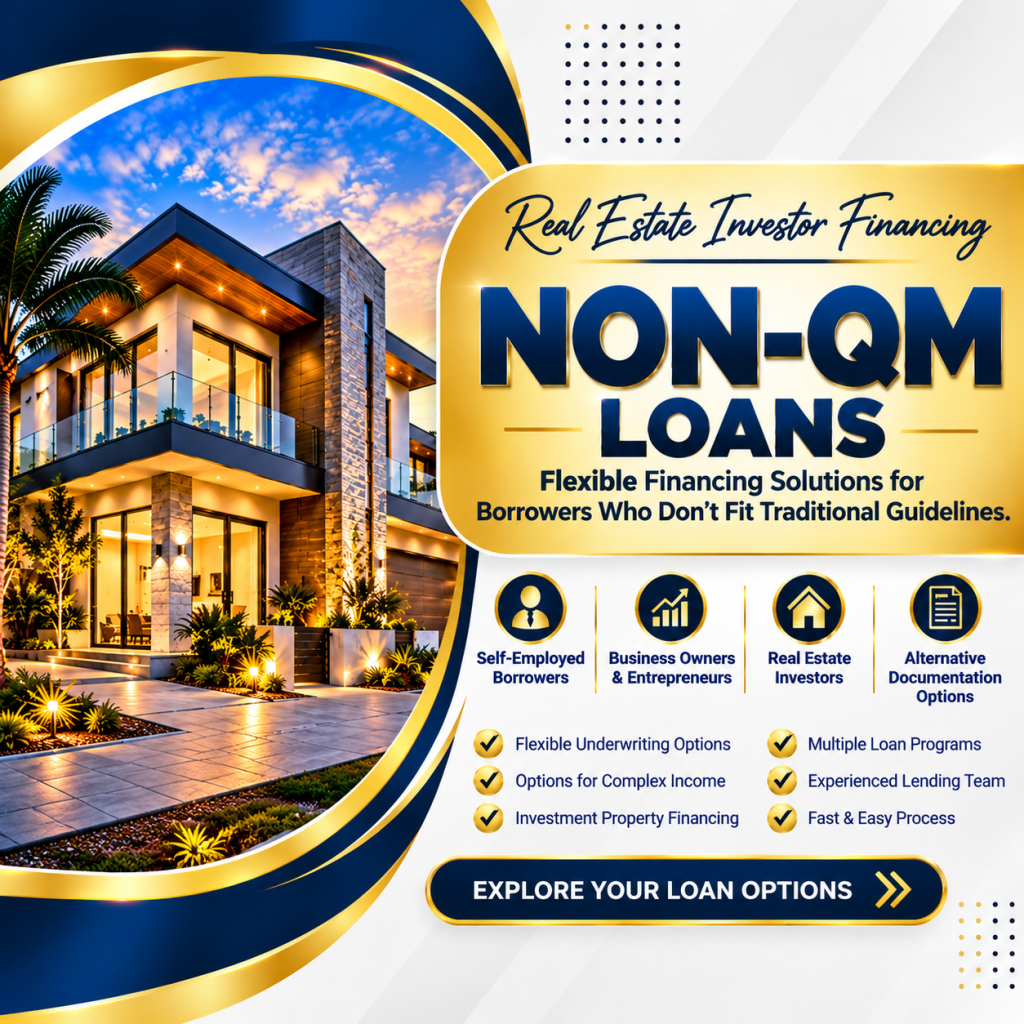
Flexible Mortgage Financing for Borrowers Who Don't Fit Traditional Lending Guidelines
Not every borrower fits the traditional mortgage lending model. Self-employed professionals, entrepreneurs, and real estate investors may have financial profiles that make qualifying for conventional financing more challenging.
Non-QM (Non-Qualified Mortgage) loans offer alternative mortgage financing options for eligible borrowers whose financial circumstances may require a different approach to qualification.
Whether you own a business, manage multiple investment properties, or generate income through several sources, a Non-QM loan may provide an alternative worth exploring.
At JCREIG Capital Funding, we focus on financing solutions for real estate investors. Our goal is to help you explore available loan programs based on your investment strategy, property, and financial circumstances.
Looking for financing options beyond traditional mortgage guidelines? Let's explore what may work for your next investment.
What Is a Non-QM Loan?
Non-QM stands for Non-Qualified Mortgage.
A Non-QM loan is a mortgage that does not meet the criteria for a Qualified Mortgage under applicable federal regulations. These loans may use alternative underwriting methods to evaluate borrowers whose financial circumstances do not fit conventional mortgage qualification standards.
Traditional mortgage underwriting often emphasizes documented income, employment history, debt obligations, and other standard qualification factors.
Depending on the Non-QM program, underwriting may evaluate financial information differently. For example, a program may consider bank statements, business cash flow, rental income, assets, or other documentation when determining whether a borrower qualifies.
Non-QM loans can be relevant to self-employed borrowers, business owners, and eligible real estate investors with complex income structures.
However, Non-QM does not automatically mean no income verification, no documentation, or easier approval. Requirements depend on the specific loan program and applicable regulations.
How Do Non-QM Loans Work?
Non-QM loans use underwriting methods that differ from those required for Qualified Mortgages.
The under writer evaluates the borrower’s financial circumstances, the property, the proposed loan structure, and the applicable program requirements.
Depending on the product, the underwriting process may consider:
- Credit history and credit score
- Income documentation and cash flow
- Bank statements or other financial records
- Business ownership and self-employment income
- Rental income from investment properties
- Available assets and financial reserves
- Existing debt obligations
- Property value and loan-to-value ratio
- The intended use of the property
Not every factor applies to every program. Your account executive can explain the requirements for the specific loan you’re considering.
The objective is to determine whether the borrower and transaction satisfy the program’s underwriting standards.
Who Can Benefit From Non-QM Loans?
Non-QM financing may be worth exploring if your financial circumstances make traditional mortgage qualification challenging.
1. Self-Employed Borrowers
Self-employed borrowers may report income differently from salaried employees. Business expenses, tax deductions, and fluctuating revenue can complicate conventional income calculations.
Certain Non-QM programs offer alternative methods of documenting eligible income.
Depending on the program, underwriter may evaluate bank statements or other financial records to assess the borrower’s ability to repay.
2. Business Owners and Entrepreneurs
Business owners may have income derived from several companies, investments, or business activities.
Although these individuals may have substantial financial resources, their income documentation may not fit a conventional mortgage application.
Certain Non-QM programs may offer alternative underwriting methods for eligible borrowers with complex financial profiles.
3. Real Estate Investors
Real estate investors may own multiple properties, operate through business entities, and generate income from rental properties or property sales.
Depending on the transaction, an investor may benefit from exploring financing programs designed around investment property income, alternative income documentation, or other qualifying factors.
Some DSCR loans fall within the broader landscape of alternative mortgage financing, although DSCR and Non-QM are not interchangeable terms.
4. Borrowers With Complex Income Structures
Borrowers who receive income from several sources may find it challenging to document their finances using conventional underwriting methods.
Certain Non-QM products may accommodate alternative documentation or income calculations, subject to program requirements.
5. Eligible Real Estate Investors Seeking Alternative Mortgage Financing
Investors who cannot qualify under a particular conventional mortgage program may want to explore alternative options.
The appropriate solution depends on the property, the borrower’s financial circumstances, the purpose of the loan, and the lender’s guidelines.
Important: Meeting one of these descriptions does not guarantee eligibility or loan approval.
Types of Non-QM Loan Programs
Non-QM is a broad category rather than a single loan product. Different programs are designed to address different borrower circumstances and financing objectives.
The following are examples of alternative mortgage and investment property financing options. Not all are necessarily classified as Non-QM products in every lending context.
Bank Statement Loans
Bank statement loans may allow eligible self-employed borrowers to document income using personal or business bank statements rather than relying exclusively on traditional tax-return calculations.
The underwriter may review deposits, business expenses, and other financial information to determine qualifying income.
These programs can be useful for certain business owners whose tax returns do not fully reflect the income calculation accepted by the lender.
Potential advantages:
- Alternative income documentation
- Options for certain self-employed borrowers
- Qualification methods that may accommodate complex business income
Considerations: The underwriter may require multiple months of bank statements, business documentation, and other supporting records. Deposits are not automatically treated as qualifying income.
DSCR Rental Loans
Debt Service Coverage Ratio (DSCR) loans are designed for qualifying investment properties and commonly evaluate the relationship between rental income and debt-service obligations.
Depending on the program, the underwriter may place greater emphasis on the property’s qualifying rental income than on the borrower’s personal employment income.
DSCR financing may be worth exploring for eligible investors purchasing or refinancing rental properties.
Potential advantages:
- Underwriting focused on investment property cash flow
- Options for eligible rental property purchases and refinances
- Certain programs that do not require traditional personal income verification
Considerations: Credit, property eligibility, rental income, equity, reserves, and other requirements may apply. Not every DSCR loan is classified as Non-QM, and program guidelines vary.
Asset-Based or Asset-Depletion Loans
Certain mortgage programs evaluate eligible assets when determining a borrower’s financial capacity.
Depending on the product, a lender may consider liquid assets or calculate qualifying income using an approved methodology based on eligible assets.
These programs may be relevant to borrowers who have substantial assets but limited traditional employment income.
Potential advantages:
- Alternative qualification methods for certain asset-rich borrowers
- Potentially suitable for borrowers with nontraditional income sources
Considerations: Asset eligibility, documentation, reserve requirements, and calculation methods vary by program.
Other Alternative-Documentation Mortgage Programs
Some Non-QM programs are designed for borrowers whose income, employment, or financial circumstances require an alternative to standard mortgage underwriting.
Depending on the product, documentation methods may include bank statements, business financial records, or other accepted evidence of income and repayment ability.
The appropriate program depends on the borrower’s circumstances and the loan’s intended purpose.
Remember: A No-Doc loan is not synonymous with a Non-QM loan. Some Non-QM products require extensive income documentation, while certain specialized programs may reduce specified documentation requirements.
What Are the Potential Benefits of Non-QM Financing?
Non-QM loans can offer several potential advantages for eligible borrowers.
Alternative Income Qualification
Certain programs allow lenders to evaluate income using methods other than conventional tax-return calculations.
This may be useful for some self-employed borrowers and business owners.
Financing Options for Complex Financial Profiles
Borrowers with multiple income sources or nontraditional financial circumstances may have additional options to explore.
Investor-Focused Financing Opportunities
Some alternative mortgage programs are designed for investment properties and may emphasize rental income, property value, or other transaction-specific factors.
More Choices for Certain Borrowers
Non-QM products offer different approaches to underwriting, allowing eligible borrowers to explore options that may not be available through a particular conventional program.
Financing That May Align With Your Circumstances
The most suitable loan depends on your financial profile, the property, and your objectives. Alternative mortgage programs may provide another route when conventional underwriting is not a good fit.
Keep in mind: Non-QM loans may involve higher interest rates, fees, reserve requirements, or other conditions. Flexibility does not guarantee lower costs or approval.
What Should You Consider Before Applying?
Before pursuing a Non-QM loan, take time to evaluate the complete financing arrangement.
Review the Interest Rate and Total Borrowing Costs
Compare the interest rate, origination fees, closing costs, and other applicable charges.
Consider the total cost over the expected period you intend to hold the loan.
Understand the Documentation Requirements
Ask the account executive which documents are required to establish eligibility.
Even programs with alternative income documentation may require bank statements, asset verification, credit checks, property records, or other supporting information.
Evaluate Your Repayment Capacity
Make sure the proposed monthly payment and other loan obligations fit your financial circumstances.
For investment properties, consider rental income, vacancy, operating expenses, maintenance, and potential changes in market conditions.
Understand the Loan Terms
Review the repayment period, prepayment provisions, interest rate structure, reserve requirements, and any other applicable conditions.
If you are financing an investment property, make sure the loan aligns with your intended exit strategy.
Compare Available Options
A Non-QM loan may be useful in some circumstances, but it is not automatically the most suitable option.
Compare eligible conventional, Non-QM, DSCR, and other financing alternatives based on your goals and qualifications.
How to Prepare for a Non-QM Loan Application
Preparing your information before speaking with an account executive can help make the initial discussion more productive.
Consider gathering the following:
- Basic borrower and business information
- Property address and type
- Purchase price or estimated property value
- Requested loan amount
- Available assets and reserves
- Relevant income or financial documentation
- Current mortgage information, if refinancing
- Rental income information, if applicable
- Your intended use of the property
- Your financing objectives and anticipated exit strategy
The exact documentation required depends on the loan program and your circumstances.
An account executive can help you understand which information is necessary to evaluate your financing options.
Why Explore Non-QM Financing With JCREIG Capital Funding?
At JCREIG Capital Funding, we focus on financing solutions for real estate investors.
We recognize that borrowers have different financial circumstances, investment objectives, and property requirements. Our approach is to help investors explore available financing options based on their specific transaction.
Depending on your investment needs and program eligibility, you may wish to explore:
- Fix & Flip financing
- DSCR rental property loans
- Multifamily financing
- Commercial real estate loans
- Mixed-use property financing
- Eligible new construction financing
- Other available investment property loan programs
Our team can help you understand the general requirements of available programs and identify options that may fit your financing objectives.
Program availability and eligibility vary. If you are specifically seeking a Non-QM mortgage, confirm that the available product is appropriate for your transaction and borrower profile.


Ready to Explore Your Non-QM Loan Options?
Your financial circumstances are unique. Your financing strategy should reflect your goals.
If conventional mortgage requirements don't align with your situation, exploring alternative financing may help you identify another path forward.
Contact JCREIG Capital Funding to discuss your real estate investment objectives and explore the loan programs that may be available for your transaction.
Let's Talk About Your Next Investment!
Call: 561-303-0334
Website: JCREIGCapitalFunding.com
Start your financing inquiry today and take the next step toward your real estate investment goals.
All loans are subject to applicable program guidelines, underwriting, borrower qualifications, property eligibility, and applicable laws and regulations. Non-QM loan availability, interest rates, fees, terms, leverage, documentation requirements, and closing timelines vary. Not all borrowers or properties will qualify. No financing is guaranteed.
You'll Be In Good Company
Get A Loan Quote, Instantly!
We understand how important it is to get a quick quote of a loan you could qualify for.
Simply use the quick quote tool below to see an estimate of the interest rate, monthly repayment, origination fees, and max loan amount.
Why Investors Choose JCREIG Capital Funding

Fast Closing
We offers industry leading loan turnaround times. Our closing speed is second to none.

Proof of Funds
After completing the application you will be issued with an immediate proof of funds letter.

Excellent Rates
Our interest only fix-and-flip loans offer competitive interest rates, ranging from 10 - 12.75%

Quick Application
The 100% online application is short and simple. It can be completed in 5 minutes or less.
Minimal Paperwork
Our loan application requires minimal paperwork and our lending team is ready to lend a hand when needed.
Interest Rate Lock
Once the term sheet is signed, the interest rate is locked in for the duration of the loan.
Repeat Client Discounts
Get steep discounts on origination fees and interest rates for continuing to work with us.
Quick Application
The 100% online application is short and simple. It can be completed in 5 minutes or less.
Fast Closing
Hard Money Loans
If you need quick access to capital from a trusted source, JCREIG Capital Funding is the perfect partner for your project.
Frequently Asked Questions About Non-QM Loans
Non-QM stands for Non-Qualified Mortgage. It refers to a mortgage that does not meet the criteria for a Qualified Mortgage under applicable regulations.
No. Depending on the product, Non-QM loans may be available for eligible owner-occupied or investment property transactions. Property use and borrower eligibility depend on the specific program.
It depends on the loan program. Some Non-QM products require tax returns, while others may use alternative documentation, such as bank statements or other accepted financial records.
No. Non-QM is a broad mortgage category, while No-Doc generally refers to specified documentation requirements. Some Non-QM loans require extensive income documentation, and program requirements vary.
Certain Non-QM programs may be available for eligible investment properties. The property’s intended use, borrower qualifications, and program requirements determine eligibility.
They can be, although pricing varies. Interest rates and fees depend on the loan program, borrower qualifications, property characteristics, leverage, and market conditions. Compare the complete borrowing costs before making a decision.
The best starting point is to discuss your financial circumstances, property, and financing goals with a qualified account executive. The account executive can explain available programs and the information needed to evaluate eligibility.