


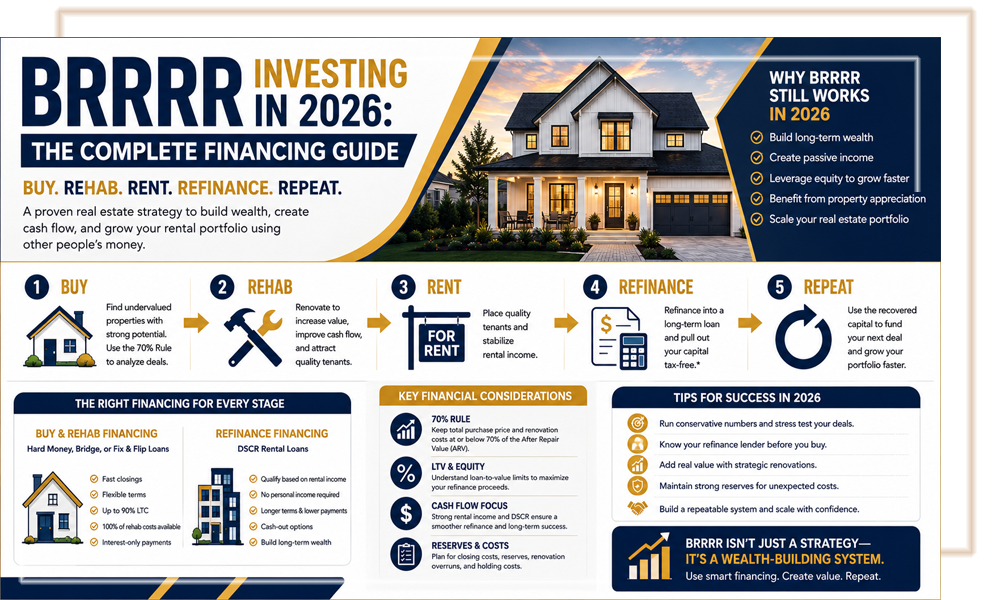
Buy • Rehab • Rent • Refinance • Repeat
If you are a real estate investor looking for a way to build a rental portfolio while recycling your available capital, the BRRRR strategy remains one of the most powerful investment models to understand in 2026.
But BRRRR investing is not simply about finding a distressed property and renovating it. The financing strategy behind the deal can determine whether you successfully recover your capital—or end up with most of your money trapped in the property.
The core concept is straightforward:
Buy an undervalued property → Rehab it → Rent it → Refinance it → Repeat the process.
The financing, however, requires considerably more planning.
In most successful BRRRR transactions, investors use one financing structure to acquire and improve the property and another financing structure to hold it long term. Short-term hard money, bridge, or fix-and-flip financing can provide the capital needed for acquisition and renovation, while a DSCR rental loan can replace the short-term debt after the property has been renovated and stabilized.
JCREIG Capital Funding specifically supports this two-stage approach, offering Fix & Flip/Bridge financing for acquisition and renovation and DSCR rental financing for the refinance stage.
This guide explains how BRRRR financing works in 2026, how to structure the numbers, what lenders look for, common mistakes to avoid, and how investors can plan the refinance before purchasing the property.
What Is the BRRRR Strategy?
BRRRR stands for:
- Buy
- Rehab
- Rent
- Refinance
- Repeat
Unlike a traditional rental purchase, where an investor generally buys a property, makes any necessary improvements, and holds it, BRRRR investing focuses on creating equity through the renovation process and then recycling invested capital through refinancing.
The objective is to acquire a property below its potential stabilized value, improve it, increase its market value and rental income, and then refinance based on the property’s post-renovation value.
The capital recovered from the refinance can potentially be used toward the next investment property.
The BRRRR financing structure
| BRRRR Stage | Primary Objective | Common Financing |
|---|---|---|
| Buy | Acquire the property | Hard Money / Bridge / Fix & Flip |
| Rehab | Complete renovations | Rehab financing / Draws |
| Rent | Stabilize property | Rental income |
| Refinance | Replace short-term debt | DSCR Rental Loan |
| Repeat | Recycle capital | Recovered equity |
The important takeaway is that BRRRR is a financing strategy as much as it is an investment strategy.
Why BRRRR Investing Still Matters in 2026
The economics of real estate investing have changed considerably over the past several years. Higher borrowing costs, changing property values, insurance expenses, taxes, construction costs, and tighter cash-flow margins have made investors more focused on capital efficiency.
That makes the financing structure of a BRRRR deal more important—not less.
Recent 2026 investor-focused lending guides continue to describe the common BRRRR financing model as short-term acquisition/rehab financing followed by a DSCR refinance after stabilization.
For investors who can identify properties with sufficient value-add potential, BRRRR can potentially provide several advantages:
- Recycle investment capital
- Build long-term rental holdings
- Create equity through improvements
- Potentially reduce the amount of cash required for subsequent acquisitions
- Build rental income over time
- Separate short-term acquisition financing from long-term rental financing
- Scale a portfolio without relying exclusively on conventional mortgages
However, BRRRR is not a guaranteed way to recover 100% of your investment. The strategy depends on the property’s actual value, renovation costs, rental income, refinance terms, market conditions, and the lender’s underwriting requirements.
Step 1: BUY — Finding the Right BRRRR Property
The first financing mistake many investors make is looking at the purchase price before looking at the exit strategy.
A property can look inexpensive and still be a poor BRRRR candidate.
The question isn’t simply:
“Can I buy this property cheaply?”
The better question is:
“Can I buy, renovate, stabilize, and refinance this property at a value that allows me to recover enough capital while maintaining acceptable cash flow?”
That distinction is critical.
What makes a good BRRRR property?
Investors should generally evaluate:
- Purchase price
- Current property value
- After-repair value (ARV)
- Renovation budget
- Comparable sales
- Expected monthly rent
- Property taxes
- Insurance
- HOA costs, if applicable
- Utilities
- Vacancy assumptions
- Property management
- Financing costs
- Closing costs
- Holding costs
- Expected refinance LTV
- Expected DSCR
- Potential cash flow after refinancing
The strongest BRRRR opportunities typically have a meaningful gap between the total project cost and the property’s stabilized value.
Understanding ARV in a BRRRR Deal
ARV stands for After Repair Value.
It represents the estimated market value of the property after the planned renovations are completed.
For example:
Purchase Price: $180,000
Renovation: $50,000
Closing/Holding Costs: $15,000
Total Project Cost: $245,000
If the completed property is worth:
ARV: $325,000
The project has created approximately:
$80,000 in gross equity
before accounting for all transaction-specific expenses and other costs.
That equity is what makes the refinance step possible.
But investors should never assume that an estimated ARV automatically becomes the appraised value.
The property must ultimately support the value used by the refinance lender.
Step 2: REHAB — Financing the Renovation
Once the property is acquired, the next challenge is funding the renovation.
Traditional mortgage financing is often not designed around distressed properties requiring significant renovation. That’s one reason investors frequently turn to private money, hard money, bridge, or fix-and-flip financing.
JCREIG Capital Funding’s Fix & Flip program, for example, is designed for investment properties requiring acquisition and renovation financing. Current published program information includes up to 90% LTC, up to 70% ARV, and financing for 100% of renovation costs, subject to program guidelines and borrower/property qualification.
Why rehab financing matters
A BRRRR investor wants the acquisition financing and renovation financing to work together.
A lender may structure the transaction with:
- A loan for the purchase
- A renovation budget
- Draws as work is completed
- Interest-only payments during the project
- A short-term maturity
- An anticipated refinance or sale as the exit
The exact structure varies by lender, property, borrower experience, location, leverage, and project economics.
Loan-to-Cost (LTC) vs. Loan-to-Value (LTV)
Understanding these two terms is essential for BRRRR investors.
Loan-to-Cost (LTC)
LTC measures the loan against the total project cost.
LTC = Loan Amount ÷ Total Project Cost
For example:
Purchase: $200,000
Renovation: $50,000
Total Cost: $250,000
If the lender provides $200,000:
$200,000 ÷ $250,000 = 80% LTC
The investor would need to bring the remaining capital, plus any costs not included in the financing.
Loan-to-Value (LTV)
LTV measures the loan against the property’s value.
LTV = Loan Amount ÷ Property Value
If the renovated property appraises for $300,000 and the loan is $225,000:
$225,000 ÷ $300,000 = 75% LTV
Understanding both measurements is important because the acquisition loan may be constrained by LTC while the eventual DSCR refinance may be constrained by LTV.
Step 3: RENT — Stabilizing the Property
The “Rent” portion of BRRRR is where the property transitions from a construction project into an income-producing investment.
This step is more important than simply finding a tenant.
The investor needs to demonstrate that the completed property supports the long-term financing strategy.
Depending on the property and loan program, stabilization may involve:
- Completing all renovations
- Obtaining required permits
- Completing inspections
- Establishing the property’s final condition
- Obtaining an appraisal
- Finding a qualified tenant
- Executing a lease
- Documenting rental income
- Establishing the property’s operating economics
The investor should have a realistic understanding of market rent before purchasing the property.
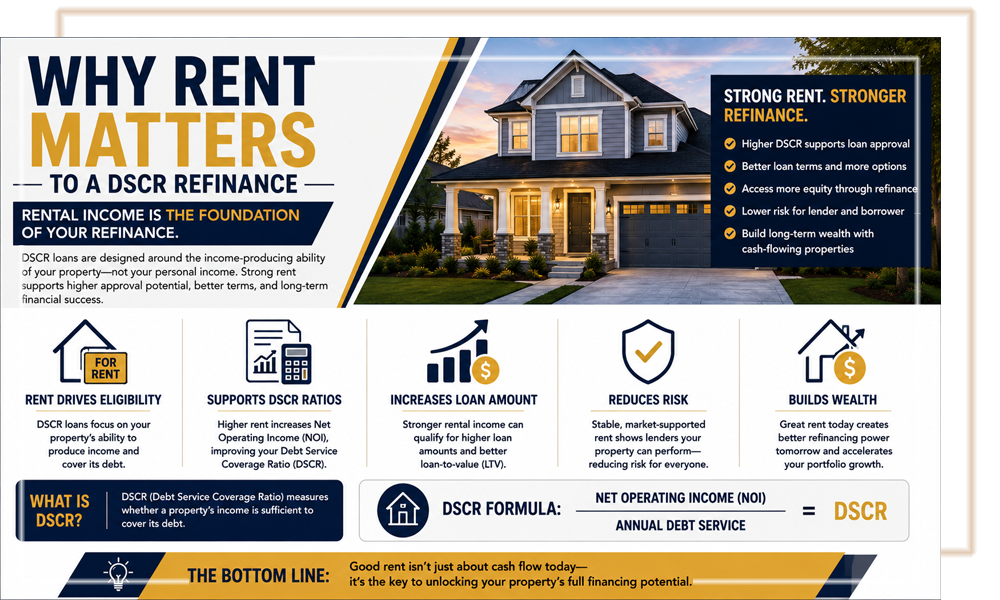
Why Rent Matters to a DSCR Refinance
A DSCR loan is generally designed around the income-producing ability of the investment property rather than relying solely on the borrower’s personal income.
JCREIG Capital Funding describes its DSCR rental program as a financing option where borrowers are qualified primarily based on the property’s income and debt-service coverage, and the program can be used for purchases, refinances, and cash-out refinances.
This can be particularly useful for real estate investors who are:
- Self-employed
- Business owners
- Full-time investors
- Building multiple rental properties
- Managing complex income sources
- Seeking an investor-focused alternative to conventional underwriting
However, DSCR does not mean “no underwriting.” The property, loan amount, rental income, credit profile, reserves, leverage, and other factors can still affect eligibility and pricing.
Step 4: REFINANCE — The Most Important Part of BRRRR
The refinance is where the BRRRR strategy either works—or doesn’t.
You can buy the right property.
You can complete a beautiful renovation.
You can find a tenant.
But if the property does not support the refinance you planned, your capital may remain trapped.
This is why experienced investors often work backward from the refinance.
How a DSCR Refinance Works
Suppose an investor completes the following project:
Purchase: $180,000
Rehab: $50,000
Other costs: $15,000
Total invested/project cost: $245,000
After renovation, the property appraises at:
$325,000
Assume the refinance lender allows a hypothetical 75% LTV:
$325,000 × 75% = $243,750
A new loan of approximately $243,750 could potentially pay off most of the original project financing.
In this simplified example, the investor could recover nearly the entire $245,000 project cost—but transaction costs, lender requirements, payoff amounts, reserves, and other factors could change the actual amount recovered.
This illustrates one of the most important concepts in BRRRR investing:
The goal isn’t simply to increase the property’s value. The goal is to create enough value to support the long-term financing while preserving acceptable cash flow.
The “Cash Back” BRRRR Calculation
A useful way to evaluate a prospective deal is to estimate the potential refinance proceeds before buying.
Example
Purchase Price: $175,000
Renovation: $45,000
Closing/Holding/Other Costs: $15,000
Total Project Cost: $235,000
Projected ARV: $325,000
Hypothetical refinance at 75% LTV:
$325,000 × 75% = $243,750
Potential gross equity available above project cost:
$243,750 − $235,000 = $8,750
This does not mean the investor automatically receives $8,750 in cash.
Actual proceeds depend on the existing loan payoff, closing costs, lender-required reserves, refinance fees, appraisal, prorations, and other transaction-specific items.
The example demonstrates why investors should model the entire transaction before purchasing.
Step 5: REPEAT — Recycling Your Capital
Once the short-term loan is paid off through the refinance, the investor can potentially redeploy recovered capital into another acquisition.
That’s the “Repeat” in BRRRR.
For example:
Deal #1
Investor starts with $100,000.
They use capital and financing to purchase and renovate Property #1.
After stabilization, the property is refinanced and a significant portion of the investor’s original capital is recovered.
That capital can then become part of the financing for:
Deal #2
The investor repeats the process.
Then:
Deal #3
And potentially:
Deal #4
This is how BRRRR can accelerate portfolio growth compared with a strategy where an investor must save an entirely new down payment for every acquisition.
But capital recycling only works when the underlying properties are financially sound.
BRRRR Financing: Hard Money vs. DSCR Loans
One of the most common questions investors ask is:
“Should I use a hard money loan or a DSCR loan for BRRRR?”
The answer is usually:
They serve different purposes.
Hard Money / Fix & Flip Financing
Best suited for:
- Acquiring distressed properties
- Properties requiring significant renovation
- Time-sensitive acquisitions
- Investors who need flexible asset-based financing
- Projects where traditional financing is difficult
DSCR Rental Financing
Best suited for:
- Stabilized rental properties
- Long-term buy-and-hold investments
- Refinancing short-term acquisition debt
- Investors who want property-based qualification
- Cash-out refinance strategies
This two-phase structure is widely discussed in 2026 BRRRR financing resources.
BRRRR Financing Options in 2026
Real estate investors have several financing tools available depending on the property and strategy.
1. Fix & Flip Loans
These are short-term loans designed to acquire and renovate investment properties.
They can be useful for the Buy + Rehab stages.
JCREIG Capital Funding currently publishes Fix & Flip financing with terms including up to 90% LTC, up to 70% ARV, renovation financing, and interest-only structures, subject to qualification and program guidelines.
2. Bridge Loans
Bridge financing can provide short-term capital when an investor needs to move quickly or when the property does not fit traditional long-term financing.
Bridge loans can be particularly useful when:
- The property needs improvements
- The investor needs speed
- The property is transitioning between financing structures
- A long-term refinance is planned after stabilization
The critical component is having a clear exit strategy.
3. DSCR Rental Loans
DSCR loans are often used as the long-term financing component of a BRRRR strategy.
Instead of primarily relying on personal employment income, DSCR underwriting focuses heavily on the property’s ability to support its debt obligations.
This can make DSCR financing attractive to investors scaling rental portfolios.
JCREIG Capital Funding offers DSCR rental financing for investment properties and describes the program as available for purchases, refinances, and cash-out refinances, including BRRRR scenarios.
4. Conventional Investment Property Loans
Conventional financing can sometimes be appropriate for investors who meet traditional underwriting requirements.
Potential advantages can include:
- Competitive long-term financing
- Conventional amortization
- Familiar underwriting structure
However, conventional financing may be less flexible for distressed properties, substantial renovations, complex investor structures, or borrowers whose income does not fit traditional underwriting.
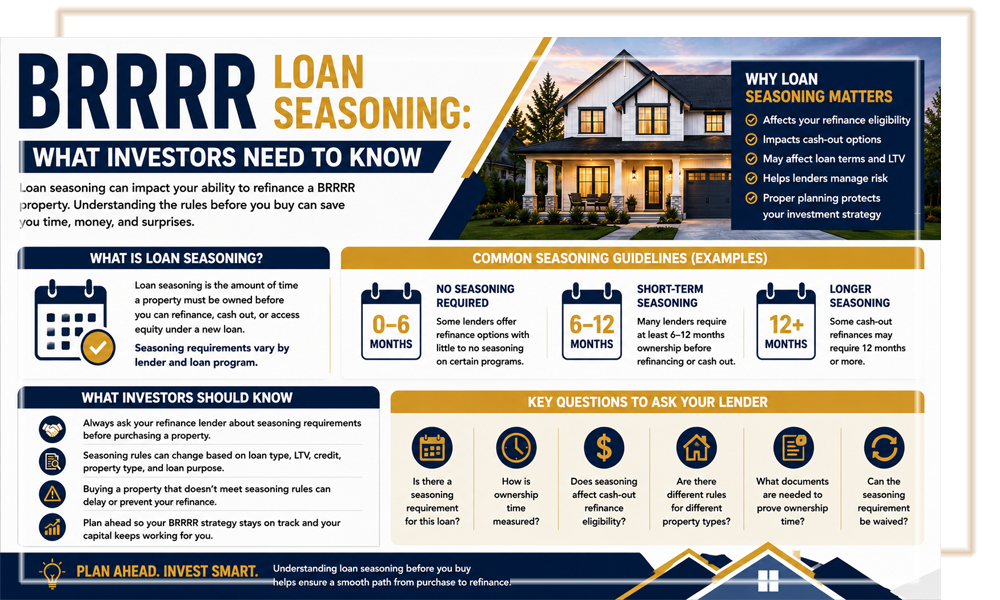
BRRRR Loan Seasoning: What Investors Need to Know
One of the most important questions to ask before beginning a BRRRR project is:
“How soon can I refinance?”
The answer depends on the refinance lender and loan program.
Some lenders may have seasoning requirements, while others may offer programs with different requirements depending on the transaction.
Don’t assume that because you finished the renovation, you can immediately obtain your desired cash-out refinance.
Before closing the acquisition loan, ask your prospective refinance lender:
- Is there a seasoning requirement?
- How is the property’s value determined?
- Will the lender use the current appraised value or another valuation method?
- How much LTV is available?
- Is a lease required?
- How is market rent calculated?
- Are reserves required?
- What credit score is needed?
- Are there prepayment penalties?
- Are there restrictions based on ownership entity?
- How long does the refinance typically take?
The refinance should be planned before the purchase—not after the rehab is complete.
The BRRRR “70% Rule” in 2026
Many investors have heard of the traditional:
70% Rule
A simplified version is:
Maximum Purchase + Rehab Budget ≈ 70% of ARV
For example:
ARV = $300,000
70% of ARV:
$300,000 × 70% = $210,000
If renovation costs are $40,000, the simplified purchase target would be approximately:
$210,000 − $40,000 = $170,000
However, investors should be careful about treating the 70% rule as a universal lending rule.
It is primarily an investment-analysis guideline.
Actual financing depends on:
- Lender guidelines
- LTC
- LTV
- ARV
- Property type
- Borrower experience
- Credit
- Liquidity
- DSCR
- Market
- Property condition
- Exit strategy
- Loan program
A lender may finance a deal outside the traditional 70% rule if the overall risk profile and economics support it.
How to Analyze a BRRRR Deal Before Making an Offer
A strong BRRRR analysis should include at least five calculations.
1. Total Project Cost
Include:
Purchase + Rehab + Closing Costs + Financing Costs + Holding Costs + Other Costs
Don’t underestimate the true cost of the project.
2. After Repair Value
Use comparable properties that are genuinely comparable.
Look at:
- Location
- Square footage
- Bedrooms
- Bathrooms
- Lot size
- Property condition
- Renovation quality
- Recent sales
- Market trends
Avoid selecting comps simply because they produce the ARV you want.
3. Expected Rent
Determine realistic market rent.
Consider:
- Similar rental properties
- Property size
- Location
- Amenities
- Condition
- Parking
- Tenant demand
- Property management
- Local rental competition
4. Refinance Proceeds
Estimate:
ARV × Expected Refinance LTV
Then subtract:
- Existing loan payoff
- Closing costs
- Prepaid items
- Reserves
- Other required deductions
This gives you a much more realistic estimate of how much capital could potentially be recovered.
5. Post-Refinance Cash Flow
Calculate:
Gross Rent
− Vacancy
− Property Taxes
− Insurance
− Maintenance
− Management
− HOA
− Utilities
− Debt Service
= Estimated Cash Flow
If the property only works because you assume perfect occupancy and zero maintenance, it probably isn’t a strong BRRRR deal.
A Complete Hypothetical BRRRR Example
Let’s look at a simplified example.
Acquisition
Purchase Price: $175,000
Renovation
Rehab Budget: $50,000
Other Costs
Closing, holding, and financing costs: $15,000
Total Project Cost
$240,000
Completed Value
Projected ARV: $325,000
Potential Refinance
Assume hypothetical 75% LTV:
$325,000 × 75% = $243,750
The new loan could potentially provide approximately $243,750 before transaction-specific costs and adjustments.
This creates the possibility of recovering a substantial portion of the original capital.
But there is another question:
What will the property rent for?
Suppose market rent is estimated at $2,600/month.
Annual gross scheduled rent:
$2,600 × 12 = $31,200
The investor then needs to determine whether that income supports the proposed refinance debt and operating expenses.
This is where DSCR becomes critical.
What Is DSCR?
DSCR stands for:
Debt Service Coverage Ratio
A simplified calculation is:
DSCR = Net Operating Income ÷ Annual Debt Service
For example, if a property’s qualifying net operating income is $24,000 and its annual debt service is $20,000:
DSCR = 1.20
A ratio above 1.00 generally indicates that the property’s qualifying income exceeds its debt service.
However, individual lenders use different methods for calculating qualifying income and expenses, so investors should not assume that their own calculation will exactly match a lender’s underwriting calculation.
Learn More About DSCR Loans & How the Debt Service Coverage Ratio Works →
Read: What Is Debt Service Coverage Ratio (DSCR) in Real Estate?
Common BRRRR Financing Mistakes
Mistake #1: Buying Based Only on the Purchase Price
A $100,000 property isn’t necessarily a bargain.
If it requires $100,000 in repairs and will only be worth $175,000 afterward, the numbers may not work.
Mistake #2: Overestimating ARV
This is one of the biggest BRRRR risks.
A projected $350,000 ARV doesn’t matter if the appraisal supports only $300,000.
A lower appraisal can dramatically reduce the amount available through refinancing.
Mistake #3: Underestimating Rehab Costs
Renovations frequently encounter:
- Structural issues
- Electrical problems
- Plumbing problems
- Roof problems
- Permit issues
- Mold
- HVAC replacement
- Material cost increases
- Contractor delays
Always leave room for unexpected costs.
Mistake #4: Ignoring Holding Costs
Every additional month can increase:
- Interest
- Insurance
- Taxes
- Utilities
- Property management
- Maintenance
- Opportunity cost
A project that takes six months instead of three can have a substantially different return.
Mistake #5: Waiting Until the End to Find a Refinance Lender
This can be disastrous.
The refinance lender should ideally be part of the plan from the beginning.
Mistake #6: Assuming You Can Pull All Your Cash Out
Even if the property has substantial equity, the refinance may be limited by:
- LTV
- DSCR
- Credit
- Reserves
- Property type
- Loan limits
- Seasoning
- Appraised value
- Loan program guidelines
Mistake #7: Ignoring the Exit Strategy
Every BRRRR deal should have an exit strategy.
The primary plan might be:
Fix → Rent → DSCR Refinance
But investors should also consider alternatives if the refinance doesn’t work as expected.
For example:
- Sell the property
- Obtain alternative long-term financing
- Bring additional capital
- Reduce the refinance amount
- Hold with the existing financing temporarily
A strong investor doesn’t simply have a Plan A.
They understand what happens if Plan A doesn’t work.
How to Improve Your BRRRR Financing Strategy in 2026
1. Start With the Exit
Before making an offer, determine:
What loan will pay off the acquisition loan?
Then determine:
What value and rental income will be required for that refinance?
2. Build Conservative Numbers
Don’t use the best-case scenario.
Model:
- Higher rehab costs
- Lower ARV
- Higher vacancy
- Higher insurance
- Higher property taxes
- Longer holding period
- Lower refinance proceeds
If the deal still works, you have a stronger investment.
3. Choose the Right Financing Partner
The right lender should understand:
- Investor financing
- BRRRR transactions
- Renovation projects
- DSCR lending
- Refinance timing
- Property valuation
- Investor exit strategies
Speed matters, but execution certainty matters just as much.
4. Know Your Loan Before You Need It
Get familiar with your lender’s:
- Maximum LTV
- Maximum LTC
- ARV requirements
- DSCR requirements
- Credit requirements
- Reserve requirements
- Seasoning policies
- Prepayment penalties
- Closing timelines
- Eligible property types
5. Think Portfolio, Not Just Property
The objective of BRRRR isn’t necessarily to make one great deal.
It is to create a repeatable acquisition system.
Your first property should help you understand:
- What neighborhoods work
- What contractors work
- What rents are achievable
- What lenders work
- What financing structure works
- What property types fit your strategy
Then repeat what works.
Can New Investors Use the BRRRR Strategy?
Yes—but new investors should be especially conservative.
A first-time BRRRR investor should focus on a project with:
- Straightforward renovations
- Strong comparable sales
- Reliable rental demand
- Conservative ARV
- Realistic rehab costs
- Multiple potential exits
- Adequate reserves
- A clearly defined refinance strategy
JCREIG Capital Funding currently states that its Fix & Flip program welcomes new investors, although individual transactions remain subject to underwriting and program requirements.
The goal isn’t to take the biggest project possible.
The goal is to successfully complete the first project and create a repeatable process.
Why the Financing Partner Matters
BRRRR investors often focus heavily on the property.
But financing can be just as important.
A lender can influence:
- How much cash you need
- How quickly you can close
- How much renovation financing is available
- How funds are drawn
- How long you have to complete the project
- Your carrying costs
- Your refinance options
- How quickly you can redeploy capital
JCREIG Capital Funding describes itself as a nationwide private hard money and Non-QM lender focused on real estate investors, with Fix & Flip, Bridge, DSCR, rental, construction, commercial, and other investment-property financing options.
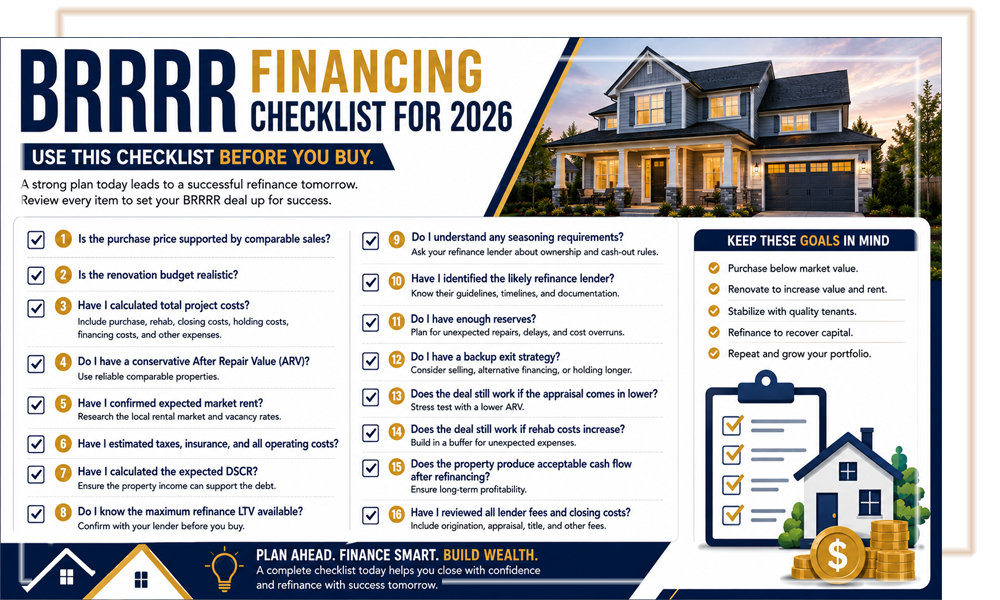
BRRRR Financing Checklist for 2026
Before purchasing a property, ask yourself:
Is the purchase price supported by comparable sales?
Is the renovation budget realistic?
Have I calculated total project costs?
Do I have a conservative ARV?
Have I confirmed expected market rent?
Have I estimated taxes and insurance?
Have I accounted for vacancy?
Have I calculated the expected DSCR?
Do I know the maximum refinance LTV?
Do I understand any seasoning requirements?
Have I identified the likely refinance lender?
Do I have enough reserves?
Do I have a backup exit strategy?
Does the deal still work if the appraisal comes in lower?
Does the deal still work if rehab costs increase?
Does the property produce acceptable cash flow after refinancing?
If the answer to several of these questions is “no,” the deal may not be ready.
BRRRR Investing in 2026: The Bottom Line
The BRRRR strategy remains fundamentally simple:
Buy. Rehab. Rent. Refinance. Repeat.
But successful BRRRR investing requires much more than finding a discounted property.
The financing needs to be designed around the entire investment lifecycle.
The acquisition loan needs to provide enough flexibility to purchase and renovate the property.
The renovation needs to create enough value to support the investment thesis.
The rental needs to generate sufficient income to support the long-term financing.
And the refinance needs to provide a realistic path to paying off the short-term debt and potentially recovering capital.
That is why the most successful BRRRR investors often think about the refinance before they buy.
In 2026, the competitive advantage isn’t simply finding a property.
It’s knowing exactly how you’re going to finance it from acquisition through stabilization—and having the right lending partner ready for every stage.
Ready to Finance Your Next BRRRR Deal?
At JCREIG Capital Funding, we help real estate investors structure financing for the different stages of their investment strategy.
Our investor-focused programs include:
- Fix & Flip Loans
- Bridge Loans
- DSCR Rental Loans
- Cash-Out Refinancing
- Purchase Financing
- Ground-Up Construction
- Multifamily Financing
- Commercial Financing
For BRRRR investors, the strategy can involve using short-term Fix & Flip or Bridge financing for the Buy + Rehab phase and transitioning into DSCR financing for the Rent + Refinance phase.
JCREIG Capital Funding’s current published information states that it provides financing nationwide and focuses on investment properties and investor-oriented lending solutions.
Have a BRRRR property under contract?
Don’t wait until the renovation is finished to think about the refinance.
Plan the financing strategy before you buy.
JCREIG Capital Funding
Real Estate Investor Financing Nationwide
Phone: (561) 303-0334
Website: JCREIG Capital Funding
FAQs
BRRRR stands for Buy, Rehab, Rent, Refinance, Repeat. The strategy involves purchasing an investment property, renovating it to increase its value, renting it, refinancing the property, and potentially using the recovered capital to purchase another investment property.
BRRRR financing commonly involves two stages of financing. Investors may use a hard money, bridge, or Fix & Flip loan to purchase and renovate the property. After the property is renovated and stabilized as a rental, the investor may refinance into a long-term rental loan such as a DSCR loan.
There is no single loan that is best for every BRRRR deal. Fix & Flip or hard money financing can be useful for purchasing and renovating properties, while DSCR rental financing can be useful for refinancing stabilized rental properties. The appropriate loan depends on the property, borrower, project economics, and exit strategy.
Yes. Hard money and private money loans are commonly used to finance the Buy and Rehab portions of a BRRRR project. These loans can be particularly useful when a property requires substantial renovations and the investor needs a short-term financing solution.
In many cases, yes. A common BRRRR strategy is to use short-term financing for acquisition and renovation and then refinance the stabilized rental property into a DSCR loan. However, lender requirements such as seasoning, appraisal, LTV, DSCR, credit, reserves, and property eligibility can affect whether the refinance qualifies.
A DSCR loan is an investor-focused rental property loan where the property’s qualifying rental income is a major factor in determining whether the property can support the proposed debt. This can make DSCR financing attractive to investors who want to refinance a BRRRR property into long-term rental financing.
The amount of capital required varies significantly by property and financing structure. Investors may need funds for down payment or equity, closing costs, reserves, renovation costs not covered by the lender, and unexpected expenses. Higher leverage and renovation financing can potentially reduce the amount of cash required, but investors should always maintain adequate reserves.
The traditional 70% rule is an investment-analysis guideline suggesting that an investor’s purchase price plus renovation costs should generally remain around 70% of the property’s ARV.
For example, if a property has an estimated ARV of $300,000, 70% would be $210,000. If the renovation is expected to cost $40,000, the simplified maximum purchase price would be approximately $170,000.
The 70% rule is not a universal lending requirement. Actual financing depends on the lender, loan program, property, borrower, leverage, and overall transaction.
ARV means After Repair Value. It is the estimated market value of the property after the planned renovations have been completed.
ARV is important because it can influence both the investment analysis and the amount of financing available. Investors should support their projected ARV with appropriate comparable properties rather than relying solely on an estimated future value.
A simplified calculation is:
Estimated ARV × Maximum Refinance LTV = Potential Gross Loan Amount
For example, if a property appraises at $300,000 and the lender allows a hypothetical 75% LTV:
$300,000 × 75% = $225,000
The actual amount available to the investor can be lower after paying off the existing loan and accounting for closing costs, reserves, fees, and other lender requirements.
Potentially. If the property’s post-renovation value and applicable LTV allow a refinance larger than the existing debt, the transaction may provide cash-out proceeds.
However, investors should not assume they will recover all of their invested capital. The amount available depends on the appraised value, LTV limits, existing loan balance, closing costs, reserves, DSCR, seasoning requirements, and the specific loan program.
DSCR stands for Debt Service Coverage Ratio. A simplified calculation compares qualifying property income with annual debt service:
DSCR = Net Operating Income ÷ Annual Debt Service
A DSCR above 1.00 generally indicates that qualifying property income exceeds the property’s debt service. Lenders may use their own specific methodology for calculating qualifying income and expenses.
DSCR loans are generally designed to evaluate the income-producing ability of the investment property rather than relying primarily on traditional personal-income qualification. However, other underwriting criteria can still apply, including credit, reserves, property type, leverage, and borrower eligibility.
The timeline varies depending on the property, renovation scope, contractors, permits, market, lender, appraisal, tenant placement, and refinance process.
A BRRRR project can take several months or longer. Investors should build realistic time and cost assumptions into their underwriting and avoid relying on an overly aggressive timeline.
Some lenders and loan programs have seasoning requirements, while others may have different rules depending on the transaction.
Before purchasing a property, investors should ask their intended refinance lender about ownership seasoning, cash-out rules, appraisal requirements, and refinance eligibility.
Yes, but beginners should generally start conservatively. A first BRRRR project may be easier to manage if it involves a straightforward renovation, strong rental demand, reliable comparable sales, realistic construction costs, and multiple potential exit strategies.
Investors should also have adequate reserves for unexpected expenses.
Common risks include:
- Overestimating ARV
- Underestimating renovation costs
- Construction delays
- Lower-than-expected rents
- Higher interest or holding costs
- Lower appraisal values
- Changes in market conditions
- Insufficient refinance proceeds
- Unexpected property issues
- Inability to meet DSCR requirements
- Insufficient reserves
The best way to manage these risks is to perform conservative underwriting before purchasing the property.
Potentially. BRRRR strategies can be applied to certain multifamily investment properties, depending on the property type, number of units, location, lender guidelines, and financing program.
Investors should confirm property eligibility and financing terms before entering into a purchase contract.
Potentially, depending on the lender’s geographic coverage and property eligibility. Investors working in multiple markets should confirm that their lender finances investment properties in the state where the property is located.
A lower appraisal can reduce the amount of financing available during the refinance.
For example, if an investor expects a $350,000 ARV but the property appraises at $300,000, the maximum refinance amount may be substantially lower than originally projected.
The investor may then need to:
- Bring additional capital
- Reduce the loan amount
- Negotiate different financing
- Hold the property longer
- Sell the property
- Pursue another exit strategy
This is why conservative ARV analysis is critical.
Yes. One of the most important BRRRR financing principles is to understand the refinance before committing to the acquisition.
Before buying, determine the likely refinance LTV, DSCR requirements, seasoning requirements, appraisal process, reserves, property eligibility, and expected closing costs.
Your acquisition financing and refinance strategy should work together from the beginning.
JCREIG Capital Funding provides investor-focused financing options that can be used for different stages of a BRRRR strategy, including Fix & Flip, Bridge, and DSCR rental financing, subject to program guidelines and underwriting.
Investors can learn more about available programs and request financing information through the JCREIG Capital Funding website.
Phone: (561) 303-0334
Website: JCREIG Capital Funding
One of the biggest mistakes is focusing on the purchase and renovation while ignoring the refinance.
A property can look like a great deal based on its purchase price and projected ARV but still fail to produce the desired refinance proceeds or rental cash flow.
Successful BRRRR analysis starts with the exit strategy and works backward.
BRRRR can still be a useful strategy in 2026 for investors who can identify properties with sufficient value-add potential and structure the financing appropriately.
However, higher costs, changing property values, insurance expenses, interest rates, rental markets, and lender requirements mean investors should analyze each property individually rather than assuming every BRRRR deal will work.
The key is buying correctly, controlling renovation costs, creating genuine value, and planning the refinance before the purchase.
Real estate investors can explore JCREIG Capital Funding’s investor financing programs, including Fix & Flip and DSCR rental financing, to better understand potential financing options for a BRRRR strategy.
Start with the numbers, understand your exit strategy, and choose financing that supports the entire lifecycle of the investment—not just the purchase.