

For real estate investors, financing can be just as important as finding the right property.
A great investment opportunity can quickly become difficult to finance when traditional mortgage underwriting focuses heavily on the borrower’s personal income, employment history, tax returns, debt-to-income ratio, and other personal financial factors.
That is one reason DSCR loans have become a popular financing option for real estate investors.
Unlike many conventional mortgage programs, a DSCR loan is designed specifically around the income-producing potential of an investment property. Instead of relying primarily on the borrower’s personal income to determine qualification, the lender evaluates whether the property’s rental income can support the proposed debt.
For investors building a rental portfolio, that difference can be significant.
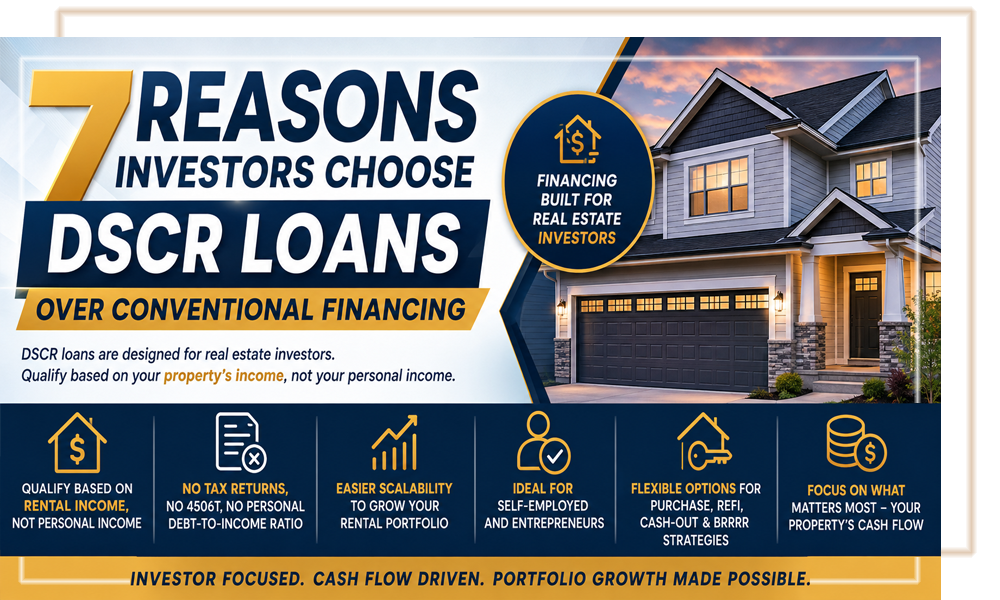
Here are seven reasons investors consider DSCR loans over conventional financing.
1. Qualification Is Based Primarily on the Property’s Cash Flow
One of the biggest advantages of a DSCR loan is the way the property itself is evaluated.
DSCR stands for Debt Service Coverage Ratio. It measures the relationship between a property’s qualifying rental income and its debt obligations.
The basic concept is:
DSCR = Qualifying Property Income ÷ Property Debt Service
For example, if a property’s qualifying monthly rental income is $3,000 and its monthly debt service is $2,500, the DSCR is 1.20.
The stronger the property’s cash-flow profile, the stronger the financing opportunity may be.
This approach can be particularly attractive to investors whose personal income doesn’t tell the complete story of their real estate investment business.
By comparison, conventional underwriting generally evaluates the borrower’s income, liabilities, assets, credit profile, and other personal financial factors. Fannie Mae’s conventional underwriting guidelines, for example, require lenders to evaluate borrower income and debt obligations when determining qualification.
For an investor, the property’s ability to generate income can be a more meaningful measure of the investment’s financial performance than a traditional W-2 income calculation.
2. DSCR Loans Can Be Attractive for Self-Employed Investors
Many successful real estate investors are entrepreneurs.
They may own multiple businesses, operate through LLCs, have income from several sources, or reinvest profits into additional properties.
Traditional mortgage underwriting can become more complicated when income comes from self-employment, partnerships, businesses, or multiple investment activities.
Conventional financing often requires extensive documentation to verify and calculate qualifying income.
DSCR financing can provide an alternative approach because the primary focus is on the investment property’s rental income and debt-service coverage rather than relying exclusively on traditional employment income.
That can make DSCR financing particularly appealing to:
- Self-employed investors
- Real estate entrepreneurs
- Business owners
- Investors with multiple income sources
- Investors whose taxable income is reduced by legitimate business deductions
- Investors growing a rental portfolio
Important: DSCR requirements vary by lender and loan program. Income documentation, reserves, credit requirements, property eligibility, and DSCR requirements should always be confirmed before applying.
3. It Can Make Scaling a Rental Portfolio Easier
Experienced investors often discover that the financing strategy used for their first rental property may not be the best strategy for their tenth.
As a portfolio grows, investors may have multiple mortgages, multiple properties, multiple income sources, and increasingly complex financial statements.
This is where investor-focused financing can become valuable.
A DSCR loan is structured around the investment property rather than treating the transaction solely as a personal mortgage.
That can help investors think about financing on a property-by-property basis.
For example, an investor may purchase a rental property, stabilize it, refinance it into long-term DSCR financing, and then use available capital toward the next investment.
This type of financing strategy is often associated with portfolio growth and strategies such as BRRRR — Buy, Rehab, Rent, Refinance, Repeat.
4. Less Emphasis on Traditional Personal Income Documentation
One of the most attractive features of DSCR financing is the potential for a simpler income-qualification process compared with conventional financing.
Depending on the specific lender and program, DSCR loans may not require the same level of traditional personal income documentation used for conventional mortgages.
That can be especially useful for investors who have:
- Complicated tax returns
- Multiple businesses
- Significant depreciation
- Variable income
- Commission-based income
- Large business deductions
- Income that doesn’t align neatly with their investment-property cash flow
Conventional financing can require detailed documentation of income and rental income. For example, Fannie Mae’s current guidelines specify documentation and calculation requirements for rental income used to qualify a borrower.
DSCR financing approaches the question differently:
Does the investment property generate enough qualifying income to support the debt?
That distinction is one of the primary reasons investors explore DSCR loans.
5. DSCR Loans Can Be Useful for Long-Term Rental Investments
DSCR financing is particularly well suited to income-producing residential investment properties.
For an investor purchasing a rental property, the ultimate objective isn’t necessarily to live in the property or earn employment income from it.
The objective is to own an asset that produces rental income.
That makes the property’s financial performance especially important.
A properly structured DSCR loan can align the financing with that investment strategy.
Investors commonly consider DSCR financing for properties such as:
- Single-family rental properties
- Townhomes
- Condominiums
- 2–4 unit investment properties
- Long-term rental properties
- Certain short-term rental properties, depending on the program
- Investment properties being refinanced after stabilization
Property eligibility varies by lender, so investors should confirm whether a specific property type and rental strategy qualifies.
6. DSCR Financing Can Provide More Flexibility for Real Estate Investors
Real estate investors don’t all fit into the same financial profile.
One investor may have a high W-2 income but only one investment property.
Another may own 15 rental properties, operate several businesses, and have relatively modest taxable income.
Another may be transitioning from fix-and-flip investments into long-term rentals.
Traditional mortgage financing isn’t always designed around the way real estate entrepreneurs operate.
Investor-focused DSCR programs can offer a different approach.
Depending on the program, investors may be able to use DSCR financing for:
Purchase:
Finance the acquisition of a rental property based largely on the property’s income-producing potential.
Rate & Term Refinance:
Refinance an existing rental property into long-term investor financing.
Cash-Out Refinance:
Access equity from an investment property for additional investment opportunities, subject to program guidelines.
BRRRR Strategy:
Purchase and renovate a property, rent and stabilize it, then refinance into long-term DSCR financing.
This flexibility can be valuable when an investor is focused on building a portfolio rather than simply purchasing a single property.
7. DSCR Loans Can Help Investors Separate Their Personal Finances From Their Investment Strategy
Real estate investing is a business.
For many investors, the goal is to build a portfolio of income-producing assets rather than rely solely on personal employment income.
DSCR financing can support that mindset by focusing underwriting attention on the investment property’s ability to support its debt.
Instead of asking only:
“How much personal income does the borrower make?”
The financing conversation becomes:
“How well does this investment property support the proposed debt?”
That can be a powerful distinction for investors who are actively building a rental portfolio.
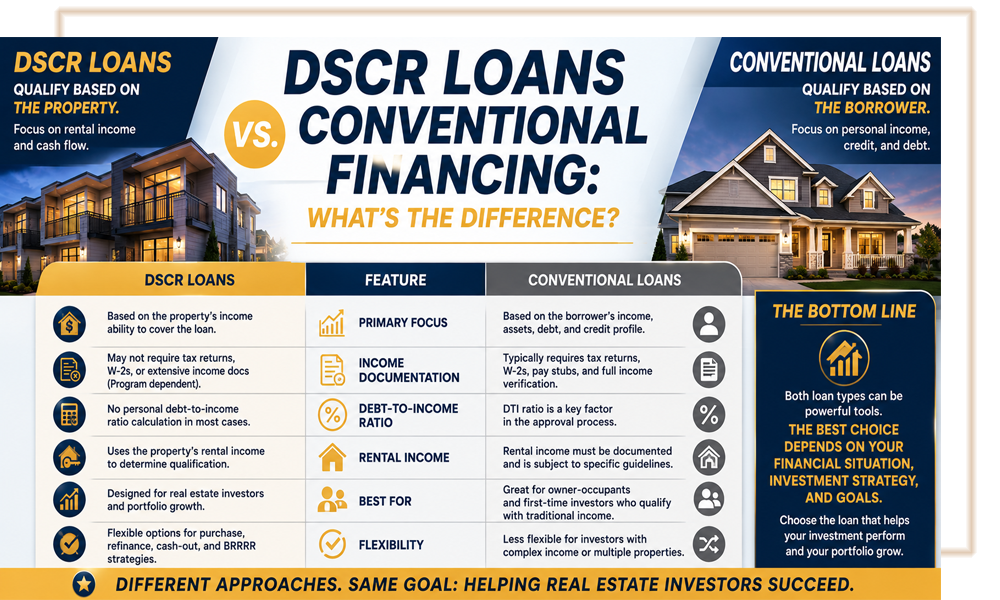
DSCR Loans vs. Conventional Financing: What’s the Difference?
While both financing options can be useful, they are designed around different underwriting philosophies.
| Feature | DSCR Financing | Conventional Financing |
|---|---|---|
| Primary focus | Investment property’s cash flow | Borrower’s overall financial profile |
| Rental income | Central to qualification | Subject to specific documentation and underwriting rules |
| Personal income | May receive less emphasis, depending on program | Typically an important qualification factor |
| Tax returns | May not be required under certain DSCR programs | Frequently required depending on borrower and income situation |
| Debt-to-income ratio | Often not the primary qualification metric | Important underwriting factor |
| Designed for investors | Yes | Can be used for investment properties |
| Portfolio investors | Often well suited | May become more complex as portfolio grows |
| Property cash flow | Central consideration | One of several considerations |
The exact requirements, rates, leverage, reserves, credit requirements, and documentation vary by lender and program.
When Does a DSCR Loan Make More Sense Than Conventional Financing?
DSCR financing may be worth considering when:
You’re buying an investment property primarily for rental income.
If the property’s income is the primary source of repayment, a DSCR structure may align well with the investment.
You’re self-employed.
If your personal income is difficult to document or doesn’t accurately reflect your investment capacity, DSCR financing may provide an alternative.
You’re growing a rental portfolio.
Investors purchasing multiple properties may benefit from financing designed specifically around investment-property cash flow.
Your tax returns don’t show your full financial strength.
Business deductions and depreciation can reduce taxable income even when an investor has substantial assets and positive cash flow.
You’re pursuing a BRRRR strategy.
DSCR financing can potentially serve as the long-term refinance component after a property has been purchased, renovated, and stabilized.
You want a financing structure designed specifically for investors.
Rather than forcing an investment strategy into a traditional owner-occupied mortgage model, DSCR financing is designed around income-producing real estate.
Is a DSCR Loan Always Better Than a Conventional Loan?
No.
The right financing depends on the property, borrower, investment strategy, loan amount, credit profile, leverage requirements, interest rate, closing costs, prepayment terms, and long-term objectives.
Conventional financing may be an excellent option for investors who qualify and want potentially competitive pricing and terms.
DSCR financing may be more attractive when the investor values property-based qualification, streamlined income documentation, portfolio flexibility, or an investor-focused underwriting approach.
The goal isn’t to choose the loan with the lowest advertised rate.
The goal is to choose the financing structure that best supports the investment.
How JCREIG Capital Funding Helps Real Estate Investors
At JCREIG Capital Funding, we specialize in financing solutions for real estate investors.
Our investor-focused loan programs can help borrowers finance rental properties, fix-and-flip projects, BRRRR strategies, ground-up construction, and other investment opportunities.
Our DSCR loan programs are designed for investors who want to qualify based primarily on the income-producing potential of their rental property rather than relying solely on traditional personal income qualification.
Depending on the program, investors may benefit from features such as:
- Investor-focused underwriting
- No traditional employment-income qualification in certain programs
- No tax returns in qualifying programs
- No personal debt-to-income calculation in qualifying programs
- Rental-income-based qualification
- Purchase and refinance options
- Financing designed for investment properties
- Nationwide investor lending options
Program guidelines, eligibility, leverage, rates, fees, and documentation requirements vary.

Final Takeaway
For real estate investors, financing is part of the investment strategy — not simply a way to purchase a property.
Conventional financing can be an excellent tool, but it isn’t always the best fit for investors with complex income, multiple properties, self-employment income, or aggressive portfolio-growth goals.
DSCR loans offer an alternative approach by placing greater emphasis on the income-producing potential of the investment property.
For investors focused on building long-term rental portfolios, that can make DSCR financing a powerful tool to have in the financing toolbox.
Looking for a DSCR lender for your next investment property? Contact JCREIG Capital Funding at (561) 303-0334 to discuss your financing options.
Ready to Explore DSCR Financing for Your Next Rental Property?
If you’re purchasing your next rental property, refinancing an existing investment, or building a larger real estate portfolio, a DSCR loan may be worth considering.
At JCREIG Capital Funding, we help real estate investors evaluate financing options based on the property and the investment strategy.
Don’t let traditional income qualification keep you from exploring your next investment opportunity.
Get Started With JCREIG Capital Funding
JCREIG Capital Funding
Investor Loans • DSCR Loans • Fix & Flip • Bridge • Ground-Up ConstructionCall: (561) 303-0334
Website: www.jcreigcapitalfunding.com
Email: info@jcreigcapitalfunding.comExplore your DSCR financing options today and see how the right loan structure can help you acquire, refinance, and grow your rental portfolio.
FAQs
A DSCR loan is an investment-property loan that evaluates the property’s ability to generate enough qualifying income to cover its debt obligations. DSCR stands for Debt Service Coverage Ratio.
Some DSCR loan programs may not require personal tax returns, but requirements vary by lender and program. Investors should confirm the documentation requirements before applying.
Potentially, yes. DSCR programs are designed around investment-property qualification, so traditional employment income may not be the primary qualifying factor. Specific credit, asset, property, and income requirements still apply.
Yes. DSCR loans are specifically designed for investment properties, subject to the lender’s property and program guidelines.
Many DSCR programs offer cash-out refinance options, subject to the lender’s requirements, maximum leverage, seasoning rules, property type, and other underwriting criteria.
They can be. A common strategy is to use short-term financing to acquire and renovate a property, stabilize it as a rental, and then refinance into long-term DSCR financing.
Credit requirements vary by lender and program. A stronger credit profile may provide access to more favorable financing options.
Not necessarily. DSCR and conventional loans serve different purposes. The best option depends on the investor’s financial profile, property, investment strategy, leverage requirements, pricing, and long-term goals.