


Top Renovations That Increase ARV: A Room-by-Room Guide for Real Estate Investors
When it comes to fix-and-flip investing, choosing the right renovations can make the difference between an average return and a highly profitable project.
Not every improvement adds equal value. Some renovations can significantly improve buyer appeal, increase marketability, and potentially raise a property’s After-Repair Value (ARV). Others may consume valuable renovation capital without producing a meaningful increase in resale value.
The key is knowing where to invest your renovation budget.
For real estate investors, the goal isn’t necessarily to create the most expensive property in the neighborhood. It’s to create a property that meets buyer expectations, competes effectively with recently sold homes, and delivers the best possible return relative to the renovation cost.
According to Zillow’s 2026 home features research, homes marketed as move-in ready and properties featuring desirable upgrades often sold for more than comparable homes. The research identified several features associated with higher sale prices, including quartzite countertops, gourmet kitchens, and outdoor entertaining spaces.
For fix-and-flip investors, these findings provide useful insight into what buyers may value when evaluating a renovated property. However, actual results depend on the local market, property condition, renovation quality, and comparable sales.
In this guide, we’ll examine the renovations that may have the greatest impact on ARV, room by room, and explain how to make smarter decisions when allocating your rehab budget.
Key Takeaways
-
- Renovations that improve functionality, appearance, and move-in readiness can strengthen buyer appeal.
- Kitchens and bathrooms are important areas to evaluate when planning a renovation.
- Updated countertops, cabinets, lighting, and appliances can help modernize a property.
- Additional bedrooms or bathrooms may improve a property’s competitive position when legally permitted and supported by comparable sales.
- Exterior improvements, including front doors, landscaping, and outdoor entertaining areas, can improve first impressions.
- Not every expensive renovation produces a higher ARV.
- Recent comparable sales should guide renovation decisions and help establish a realistic resale value.
- Investors should evaluate renovation costs against potential resale value, holding expenses, financing costs, and expected profit.
Which Renovations Tend to Add the Most Value at Resale?
One of the biggest mistakes fix-and-flip investors make is renovating a property based on personal preferences instead of what buyers in that particular market actually want.
A luxury kitchen may be attractive, but if surrounding properties have standard finishes, the additional investment may not produce a corresponding increase in resale value.
The most effective renovation strategy starts with understanding the target buyer and the neighborhood.
Zillow’s March 2026 research analyzed more than two million listings and identified several property features associated with higher-than-expected sale prices.
Features Associated With Higher Sale Prices
| Property Feature | Reported Sale Price Difference |
|---|---|
| Quartzite countertops | +5.3% |
| Outdoor kitchen | +4.4% |
| Custom features | +3.2% |
| Gourmet kitchen | +3.0% |
| Quartz countertops | +3.0% |
| Turnkey / move-in ready | +2.9% |
| Outdoor fireplace | +2.8% |
| Remodeled properties | +2.2% |
| Fixer-upper properties | -14% |
Source: Zillow 2026 Home Features Research. These figures reflect observed listing-related sale price differences compared with similar homes; they are not guaranteed returns or estimates of renovation ROI.
The findings suggest that buyers may place a premium on properties that feel complete, updated, functional, and ready for immediate occupancy.
For investors, that creates an opportunity: acquire a property that needs improvement, identify the upgrades buyers value most, and complete renovations that bring the property in line with the strongest comparable sales.
JCREIG Investor Tip: Before establishing your renovation budget, review recently sold properties in the immediate area. Identify which finishes, layouts, and features appear in the highest-performing comparable properties.
1. Kitchen Renovations: One of the Most Important Areas to Upgrade
The kitchen is often one of the first areas buyers evaluate when viewing a property.
An outdated kitchen can make an otherwise attractive home feel old, while a modern, functional kitchen can create a strong impression and help buyers envision themselves living in the property.
Zillow’s 2026 research found that listings mentioning gourmet kitchens sold for approximately 3% more than expected, while listings mentioning quartzite countertops showed a 5.3% premium.
These findings make the kitchen an important area to consider when developing a renovation strategy.
Kitchen Upgrades Worth Considering
Cabinet Refacing or Replacement
Replacing outdated cabinets can dramatically change the appearance of a kitchen. However, if the existing cabinet boxes are structurally sound, repainting or refacing them may provide a more cost-effective alternative.
Consider:
- Modern cabinet colors
- Updated doors and drawer fronts
- Contemporary hardware
- Soft-close hinges and drawers
- Improved cabinet organization
Countertops
Countertops are among the most visible kitchen features.
Popular options include:
- Quartz
- Quartzite
- Granite
- Other durable engineered or natural stone surfaces
Quartzite appeared among the highest-performing features in Zillow’s research. Quartz was also associated with a positive sale price difference.
The best material depends on the property’s price range, local buyer expectations, durability requirements, and renovation budget.
Kitchen Lighting
Good lighting can make a kitchen feel brighter, larger, and more inviting.
Consider:
- Recessed ceiling lighting
- Pendant lights over kitchen islands
- Under-cabinet lighting
- Updated fixtures over dining or breakfast areas
Appliances
A consistent appliance finish can give the kitchen a more cohesive appearance.
Depending on the property and market, consider stainless steel or other coordinated appliance packages.
Kitchen Layout and Functionality
If the existing layout is inefficient, consider whether modest changes could improve functionality.
For example, improving the work triangle between the refrigerator, stove, and sink may make the kitchen more practical without requiring a complete redesign.
Minor Kitchen Remodel vs. Complete Renovation
A complete kitchen renovation is not always necessary.
The 2025 Remodeling Impact Report from the National Association of Realtors (NAR) and the National Association of the Remodeling Industry (NARI) estimated that both minor and complete kitchen upgrades recovered approximately 60% of their cost.
This suggests that a carefully planned cosmetic renovation may be worth evaluating before committing to a more expensive reconstruction.
JCREIG Investor Tip: Don’t automatically replace everything. If the cabinets, plumbing, and layout are in good condition, concentrate your budget on the finishes buyers notice most.
2. Dining and Gathering Areas: Create Spaces Buyers Can Envision Using
Today’s buyers often appreciate open, comfortable living spaces where family and guests can gather.
A property with a functional connection between the kitchen, dining area, and living room may feel more spacious and inviting.
Depending on the existing layout, relatively modest improvements can help create a more appealing environment.
Renovations to Consider
Open Up the Floor Plan
If the kitchen and dining area feel disconnected, evaluate whether opening a wall could improve the layout.
Before removing any wall, have a qualified contractor or structural engineer determine whether it is load-bearing and identify any electrical, plumbing, or mechanical systems that may be affected.
Improve Dining Room Lighting
A modern statement fixture centered above the dining area can help define the space.
Create a Functional Dining Area
Make sure the room can comfortably accommodate an appropriately sized dining table and seating.
Improve the Connection Between Indoor and Outdoor Spaces
Where the property layout allows, consider improvements that make patios, decks, and outdoor entertaining areas feel like natural extensions of the interior.
Zillow’s research associated outdoor kitchens with a 4.4% sale premium and outdoor fireplaces with a 2.8% premium.
These features may be especially relevant in markets where outdoor living is an important part of the buyer experience.
JCREIG Investor Tip: Before investing in major structural changes, consider whether furniture placement, lighting, flooring continuity, and fresh paint could create a more open appearance at a fraction of the cost.
3. Bathroom Renovations: Improve Functionality and Buyer Appeal
Bathrooms are another important area buyers evaluate when comparing properties.
An outdated bathroom can make a renovated home feel incomplete, even when the kitchen and living areas look impressive.
A bathroom renovation does not always require moving plumbing or completely rebuilding the space.
Bathroom Improvements Worth Considering
Updated Vanities and Countertops
Modern vanities, attractive countertops, and updated fixtures can significantly improve the appearance of a bathroom.
Walk-In Showers
Where appropriate for the property and target buyer, a modern walk-in shower with attractive tile and quality glass enclosures can create a more contemporary appearance.
Lighting and Mirrors
Updated lighting, mirrors, and fixtures can make smaller bathrooms feel brighter and more spacious.
Flooring and Tile
Replacing outdated flooring and damaged tile can help create a clean, consistent appearance throughout the home.
Adding a Half Bathroom
A powder room can improve functionality, particularly in properties where guests would otherwise need to use a primary or shared bathroom.
However, adding a bathroom requires careful evaluation of plumbing access, construction expenses, permits, and local comparable sales.
Could an Additional Bedroom or Bathroom Increase ARV?
Adding a bedroom or bathroom may change how a property competes in the local market.
For example:
- Converting a suitable den or bonus room into a bedroom may appeal to buyers who need additional sleeping space.
- Adding a half bathroom may improve convenience for families and guests.
- Updating an existing guest bathroom may help the property compete with renovated listings.
The 2025 Remodeling Impact Report estimated that a new bathroom recovered approximately 56% of its cost, while a bathroom renovation recovered approximately 50%.
These figures are industry estimates, not guarantees for individual projects.
Before adding a bedroom or bathroom, investors should verify local building requirements, permitting, plumbing feasibility, and applicable bedroom definitions.
JCREIG Investor Tip: Compare properties with similar bedroom and bathroom counts before deciding whether an additional room will meaningfully improve your ARV. A renovation only adds value if the market recognizes it.
4. Front Entry and Exterior Improvements: Make a Strong First Impression
First impressions matter.
The exterior is the first thing prospective buyers see when they arrive at a property. An attractive entry, clean landscaping, and well-maintained exterior can influence how buyers perceive the entire home.
For fix-and-flip investors, exterior improvements can sometimes deliver meaningful visual impact without requiring a major renovation budget.
Exterior Improvements Worth Considering
Replace the Front Door
The 2025 Remodeling Impact Report estimated that a new steel front door could recover approximately 100% of its cost, making it one of the strongest-performing projects in the report.
A fiberglass front door was estimated to recover approximately 80%.
Update Exterior Lighting
Modern exterior fixtures can improve the property’s appearance and provide better illumination around entryways and walkways.
Refresh Landscaping
Consider:
- Trimming overgrown shrubs
- Adding fresh mulch
- Planting seasonal flowers
- Cleaning walkways
- Improving lawn condition
- Adding attractive landscape lighting
Update House Numbers and Hardware
Small improvements such as modern house numbers, door handles, and mailbox fixtures can make the exterior feel more complete.
Fresh Exterior Paint
Where necessary, repainting or repairing exterior surfaces can improve curb appeal and protect the property from deterioration.
JCREIG Investor Tip: Don’t overlook the front of the property when building your rehab budget. A clean, attractive exterior can help generate stronger interest before buyers even walk through the front door.
5. Outdoor Living Areas: Extend the Usable Space
Outdoor living has become an important consideration for many homebuyers.
Depending on the market, buyers may appreciate patios, decks, outdoor kitchens, and comfortable spaces for entertaining.
For investors, these improvements can help differentiate a property from competing listings.
Outdoor Renovations to Consider
Outdoor Kitchens
An outdoor kitchen may include:
- Built-in or freestanding grills
- Countertop preparation areas
- Outdoor storage
- Sink installations, where practical
- Covered seating areas
Zillow’s 2026 research associated listings mentioning outdoor kitchens with a 4.4% sale premium.
Patios and Decks
A clean, functional patio or deck can create additional usable space without expanding the home’s interior footprint.
Outdoor Fireplaces and Fire Pits
Outdoor fireplaces were associated with a 2.8% sale premium in Zillow’s research.
The investment should be appropriate for the climate, property type, and neighborhood.
Landscaping and Outdoor Lighting
Well-planned landscaping, lighting, and seating areas can help create a finished appearance.
Important Consideration
Outdoor improvements should be evaluated carefully against their installation and maintenance costs.
An elaborate outdoor kitchen may make sense in a higher-end market but may not provide sufficient value in a neighborhood where buyers prioritize affordability and basic functionality.
JCREIG Investor Tip: Review comparable properties to see whether outdoor amenities are common in the neighborhood and whether buyers appear willing to pay more for them.
6. Flooring, Paint, and Interior Finishes: Complete the Renovation
Even when the major renovations are complete, outdated flooring, damaged walls, or inconsistent finishes can make a property feel unfinished.
These improvements may not always produce a measurable premium individually, but they contribute to the overall presentation of the home.
Improvements Worth Considering
Flooring
Replace damaged or outdated flooring with durable materials appropriate for the property’s price point.
Popular options may include:
- Luxury vinyl plank
- Engineered hardwood
- Tile
- Refinished existing hardwood
Interior Paint
Fresh paint is one of the most cost-effective ways to improve a property’s appearance.
Neutral colors can help create a clean, consistent look that appeals to a broader range of buyers.
Interior Doors and Hardware
Replacing damaged doors and outdated handles can provide a more finished appearance.
Trim and Baseboards
New or repaired trim, baseboards, and door casings can help make a renovation look professionally completed.
Lighting and Electrical Fixtures
Replace outdated fixtures where appropriate and ensure electrical work is completed by qualified professionals.
JCREIG Investor Tip: Consistency matters. A property with coordinated flooring, paint, lighting, and hardware often presents better than one with expensive upgrades that don’t work together.
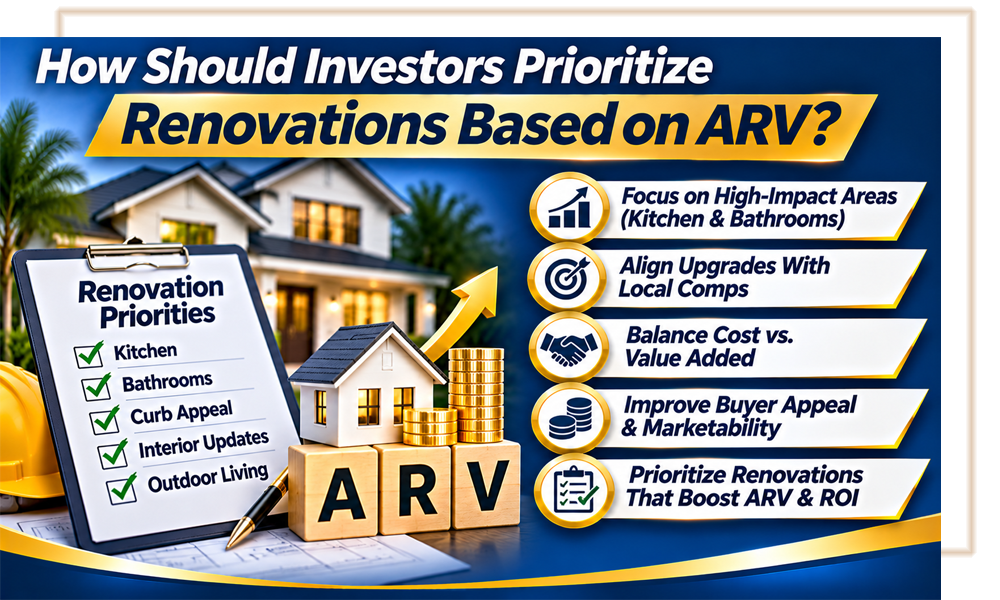
How Should Investors Prioritize Renovations Based on ARV?
The most profitable renovation is not necessarily the most expensive one.
Successful fix-and-flip investors evaluate each improvement based on its potential effect on resale value, the cost of completing the work, and the property’s position within the local market.
Before approving a renovation, consider the following:
| Renovation | Potential Buyer Benefit | Budget Consideration |
|---|---|---|
| Kitchen refresh | Modern appearance and functionality | Compare cosmetic updates with full replacement |
| Bathroom upgrade | Improved comfort and presentation | Avoid unnecessary plumbing relocation |
| Additional bedroom | Potentially broader buyer appeal | Verify legal bedroom requirements |
| Additional bathroom | Improved convenience | Evaluate plumbing and permitting costs |
| New front door | Better curb appeal | Compare material and installation costs |
| Flooring and paint | Move-in-ready appearance | Focus on durability and consistency |
| Outdoor kitchen | Expanded entertaining space | Confirm neighborhood demand |
| Landscaping | Stronger first impression | Prioritize visible improvements |
The right combination depends on the property and its competitive market.
How to Use Comparable Sales to Protect Your ARV
One of the most important steps in a fix-and-flip project is establishing a realistic After-Repair Value before beginning construction.
ARV represents the estimated market value of a property after planned renovations are completed.
It helps investors evaluate whether a property acquisition and renovation project makes financial sense.
Step 1: Analyze Recent Comparable Sales
Look for three to five recently sold properties in the immediate area that are similar in:
- Location
- Square footage
- Bedroom and bathroom count
- Property type
- Lot size
- Overall condition
- Renovation quality
Step 2: Identify Features in Higher-Priced Properties
Review the strongest comparable sales and identify which upgrades appear to distinguish those properties.
Look for:
- Updated kitchens
- Modern bathrooms
- Quality flooring
- Improved curb appeal
- Outdoor amenities
- Functional layouts
- Move-in-ready condition
Step 3: Establish a Realistic Renovation Budget
Create an itemized renovation budget that includes materials, labor, permits, contractor expenses, and contingency reserves.
Avoid estimating costs based solely on appearance or online renovation averages.
Obtain contractor estimates whenever possible.
Step 4: Calculate the Potential ARV
Use comparable sales and appropriate adjustments to estimate what the property may realistically sell for after renovations.
Do not assume that a feature’s reported percentage premium will automatically apply to your property.
Step 5: Evaluate the Entire Investment
Your project analysis should include:
- Purchase price
- Renovation costs
- Financing costs
- Closing expenses
- Property taxes
- Insurance
- Utilities
- Holding costs
- Selling expenses
- Contingency reserves
- Expected resale value
A higher ARV does not automatically mean a more profitable project if renovation expenses increase faster than the property’s market value.
Example: Why Renovation Planning Matters
Consider an investor evaluating a property with an estimated as-is market value of $350,000.
After reviewing comparable sales, the investor determines that similar fully renovated properties may sell for approximately $360,000.
The investor now has to determine whether the renovation scope can be completed at a cost that supports the desired profit margin.
The important questions include:
- Which renovations are necessary to compete with nearby properties?
- Which upgrades are likely to attract the target buyer?
- How much will each improvement cost?
- What is the expected resale value?
- How much will financing and holding expenses add to the total investment?
- What profit margin remains after all expenses?
This is why experienced investors evaluate the numbers before beginning construction.
The goal is not simply to create a beautiful property. It is to create a marketable property at a cost that supports a profitable investment.
Common Renovation Mistakes Fix-and-Flip Investors Should Avoid
Even experienced investors can lose profitability by making renovation decisions without properly evaluating the market.
Here are several mistakes worth avoiding.
1. Over-Improving the Property
Installing luxury finishes that exceed neighborhood standards may not produce a corresponding increase in resale value.
2. Ignoring Comparable Sales
A renovation plan should be based on what buyers are paying for similar properties, not simply what the investor prefers.
3. Underestimating Construction Costs
Labor, materials, permits, and unexpected repairs can quickly increase the renovation budget.
4. Changing the Scope Mid-Project
Unplanned upgrades can create delays, increase costs, and reduce the expected profit margin.
5. Overlooking Functional Problems
Cosmetic improvements will not compensate for major issues involving plumbing, electrical systems, roofing, structural components, or other essential property systems.
6. Forgetting Holding Costs
Every additional week a property remains under renovation or unsold can increase financing, insurance, utility, and other carrying expenses.
7. Failing to Budget for Contingencies
Older properties frequently reveal unexpected problems once construction begins. Maintaining a contingency reserve can help protect the project from unplanned expenses.
How JCREIG Capital Funding Supports Fix-and-Flip Investors
At JCREIG Capital Funding, we understand that successful real estate investing requires more than finding an attractive property.
Investors need financing that supports their acquisition, renovation, and resale strategies.
Our Fix & Flip and Rehab Loan programs are designed for eligible real estate investors seeking financing for residential investment properties.
Depending on the program and transaction, financing options may include:
- Up to 90% loan-to-cost (LTC)
- Up to 100% of eligible renovation costs
- Financing based on the property’s after-repair value (ARV)
- Loan amounts starting at $100,000
- No personal income documentation on select programs
- Flexible financing options for experienced and qualifying newer investors
- Streamlined underwriting and funding processes
All leverage, loan amounts, eligibility, and terms are subject to borrower qualifications, property evaluation, underwriting, and applicable program guidelines.
Planning Your Next Fix-and-Flip Project?
Before purchasing your next investment property, it is important to understand the acquisition costs, renovation budget, projected ARV, and financing structure.
JCREIG Capital Funding works with real estate investors to evaluate financing options that may support their investment strategy.
Whether you’re purchasing your first renovation property or expanding an established portfolio, we can help you explore available financing solutions.

Final Thoughts: Renovate With a Strategy, Not Just a Budget
The best fix-and-flip projects are not necessarily the ones with the largest renovation budgets.
They are the projects where investors understand the local market, identify the improvements buyers value, manage construction costs, and establish a realistic ARV before committing capital.
A refreshed kitchen, updated bathrooms, attractive flooring, a welcoming entrance, and functional outdoor spaces can all contribute to a property’s appeal.
However, every renovation should be evaluated against the property’s location, comparable sales, target buyer, and expected return.
At JCREIG Capital Funding, we believe successful real estate investing starts with informed decisions and a financing strategy that supports the entire project.
Find the right property. Plan the right renovations. Know your numbers. Build your next successful investment.
Ready to Finance Your Next Fix-and-Flip Project?
Explore investor-focused financing solutions with JCREIG Capital Funding.
JCREIG Capital Funding
Financing Solutions for Real Estate InvestorsReady to discuss your next Fix and Flip Loan option?
Complete on online quote form JCREIGCapitalFunding.com or call 866-303-0334 to learn more about our real estate investor financing programs.
Frequently Asked Questions About Renovations That Increase ARV
Kitchen and bathroom upgrades, updated flooring, fresh interior paint, improved curb appeal, and functional outdoor living spaces are among the renovations investors commonly consider. The best improvements depend on local buyer preferences, comparable sales, property condition, and the neighborhood’s price range.
A kitchen remodel can improve buyer appeal and potentially increase a property’s resale value. Popular improvements include updated cabinets, quartz or quartzite countertops, modern appliances, improved lighting, and functional layouts. A cosmetic kitchen renovation may be more cost-effective than a complete reconstruction when the existing layout is functional.
Bathroom renovations can improve a property’s marketability and help it compete with updated homes in the area. Popular improvements include modern vanities, updated tile, walk-in showers, new fixtures, improved lighting, and contemporary finishes. Investors should compare renovation costs against the prices of similar renovated properties nearby.
Adding a bedroom or bathroom may increase buyer appeal and potentially place the property in a stronger comparable-sales category. However, investors should evaluate construction costs, plumbing requirements, permits, local building codes, and whether comparable properties support the additional value.
Yes. Curb appeal can influence buyers’ first impressions and overall interest in a property. Improvements such as landscaping, exterior paint, updated lighting, a new front door, and clean walkways can help create a more attractive presentation without necessarily requiring a major investment.
Current market value represents what a property may be worth in its present condition. After-Repair Value (ARV) is the estimated market value after planned renovations have been completed. Real estate investors use ARV to evaluate potential resale proceeds and determine whether an acquisition and renovation project makes financial sense.
Investors typically estimate ARV by analyzing recently sold comparable properties in the same neighborhood with similar square footage, bedroom and bathroom counts, property types, and renovation quality. Adjustments should account for meaningful differences between the subject property and comparable sales. A realistic ARV should be supported by market evidence rather than optimistic projections.
Not necessarily. Luxury finishes may be appropriate in higher-priced neighborhoods where buyers expect premium features. In other markets, standard but attractive finishes may provide a better balance between renovation costs and potential resale value. The goal is to renovate according to neighborhood standards without over-improving the property.
The renovation budget depends on the property’s condition, required repairs, labor costs, material selections, project timeline, and desired finish level. Investors should obtain contractor estimates, include a contingency reserve, and account for financing and holding expenses before finalizing their budget.
JCREIG Capital Funding offers investor-focused Fix & Flip and Rehab financing programs for eligible real estate investors. Depending on the transaction and applicable program guidelines, financing may include purchase funding, eligible renovation costs, and leverage based on the property’s projected After-Repair Value. Borrower qualifications, property eligibility, underwriting, and program terms apply.
Ready to Finance Your Next Renovation Project?
Visit JCREIGCapitalFunding.com or call 866-303-0334 to discuss your next fix-and-flip investment.
Disclaimer: This article is provided for general educational and informational purposes only and does not constitute financial, investment, construction, or tax advice. Reported sale price premiums and remodeling cost-recovery estimates are based on third-party research and should not be interpreted as guaranteed increases in ARV or renovation returns. Actual results vary by property, location, market conditions, renovation quality, and buyer demand. Investors should conduct independent market research, obtain qualified contractor estimates, and consult appropriate professionals before undertaking renovation projects.