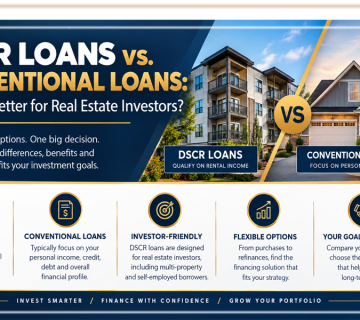



Understanding credit requirements, rental income, DSCR ratios, down payments, cash reserves, and documentation for investment property financing.
Real estate investors looking to purchase or refinance rental properties often want financing that evaluates the investment property’s income potential rather than relying exclusively on traditional employment income and personal tax returns.
That’s where a Debt Service Coverage Ratio (DSCR) loan can make a difference.
DSCR loans are designed specifically for real estate investors who want to acquire, refinance, or expand their rental property portfolios. Unlike conventional mortgages, which typically rely heavily on personal income and debt-to-income calculations, DSCR financing focuses primarily on the property’s ability to generate sufficient rental income to cover its mortgage obligations.
At JCREIG Capital Funding, we specialize in investor-focused financing solutions designed around the realities of real estate investing. Our DSCR rental loan programs offer flexible financing options for qualified investors, including self-employed borrowers, business owners, and experienced real estate investors.
Whether you’re purchasing your first rental property, refinancing an existing investment, or expanding a portfolio of income-producing properties, understanding the qualification requirements can help you prepare and move forward with confidence.
In this guide, we’ll explain what lenders look for when evaluating a DSCR loan application and what you should know before applying.
What Are the Main DSCR Loan Requirements?
Although requirements vary by lender, property type, and loan program, most DSCR lenders evaluate several important factors when reviewing an investment property loan.
These generally include:
| Qualification | What Lenders Evaluate |
|---|---|
| Credit Score | Credit history and overall borrower profile |
| DSCR Ratio | Property rental income compared with qualifying debt obligations |
| Loan-to-Value (LTV) | Loan amount compared with the property’s appraised value |
| Down Payment | Available funds required to complete the transaction |
| Cash Reserves | Available liquid assets after closing |
| Rental Income | Existing lease income or qualifying market rent |
| Property Eligibility | Property type, condition, and intended use |
| Appraisal | Market value and rental income evaluation |
| Documentation | Credit, asset, property, and entity documentation |
| Ownership Structure | Individual, LLC, or approved business entity |
One of the biggest advantages of DSCR financing is that qualifying borrowers may not need traditional employment verification, personal income calculations, or tax returns.
However, lenders may still require certain financial, credit, property, and business documentation.
How Does a DSCR Loan Work?
A DSCR loan measures whether an investment property generates enough qualifying rental income to cover its debt obligations.
The Debt Service Coverage Ratio is generally calculated using the following formula:
DSCR = Qualifying Rental Income ÷ Qualifying Debt Obligations
For residential rental properties, lenders commonly evaluate rental income against the property’s monthly PITIA payment:
Principal
Interest
Taxes
Insurance
Association dues, when applicable
Understanding DSCR Ratios
Consider the following example:
An investment property generates $2,500 in qualifying monthly rental income.
The property’s monthly PITIA payment is $2,000.
The calculation would be:
$2,500 ÷ $2,000 = 1.25 DSCR
This means the property generates 25% more qualifying rental income than its calculated monthly debt obligation.
Here is how different DSCR ratios are generally interpreted:
| DSCR Ratio | General Interpretation |
|---|---|
| Below 1.00x | Rental income is below the calculated debt obligation |
| 1.00x | Rental income covers the calculated debt obligation |
| 1.10x | Rental income exceeds the obligation by 10% |
| 1.20x | Rental income exceeds the obligation by 20% |
| 1.25x or higher | Stronger income coverage |
JCREIG Capital Funding offers DSCR rental loan options with a minimum DSCR starting at 1.00x, subject to property eligibility, borrower qualifications, and applicable program guidelines.
A lower DSCR does not automatically mean a property cannot qualify. Different loan programs may offer different qualification options.
For more information, visit our DSCR Rental Loan Programs.
What Credit Score Do You Need for a DSCR Loan?
Credit score requirements depend on the lender, loan program, property type, and overall transaction.
Unlike conventional mortgages, DSCR programs may offer more flexibility when evaluating borrowers because the property’s rental income plays a significant role in qualification.
Lenders may consider:
Credit score and payment history
Previous mortgage payment performance
Significant credit events
Existing real estate financing
Loan-to-value ratio
Property cash flow
Available reserves
A stronger credit profile may help investors access more favorable interest rates, higher leverage, or additional financing options.
At JCREIG Capital Funding, we evaluate investment scenarios individually rather than relying on a single qualification factor.
If your credit profile isn’t perfect, it may still be worth reviewing your financing options.

What DSCR Ratio Is Required to Qualify?
The minimum DSCR requirement varies by program.
Some lenders require a ratio above 1.00x, while others offer programs that allow properties with lower debt service coverage ratios under specific circumstances.
For example:
1.00 DSCR: Qualifying rental income covers the calculated debt obligation.
1.15 DSCR: Qualifying rental income exceeds the obligation by 15%.
1.25 DSCR: Qualifying rental income exceeds the obligation by 25%.
A higher DSCR may help investors qualify for more favorable financing terms, depending on the program.
Before applying, investors should understand how the lender calculates qualifying rental income and debt obligations.
Questions worth asking include:
Is the lender using existing lease income or market rent?
Are property taxes and insurance included?
Are HOA expenses included in the calculation?
Does the program allow a DSCR below 1.00x?
Does a higher DSCR qualify for better pricing?
Understanding these calculations before submitting an application can help investors identify potential qualification issues early.
How Much Down Payment Is Required for a DSCR Loan?
One of the most common questions investors ask is how much money they need upfront.
The required down payment depends on the property’s value, loan-to-value ratio, borrower qualifications, and the specific loan program.
At JCREIG Capital Funding, eligible DSCR financing options may offer:
Up to 80% LTV on qualifying investment property purchases.
This means qualified investors may be able to finance up to 80% of the property’s eligible value, depending on program guidelines.
Example: DSCR Loan Down Payment
Consider an investment property with a purchase price of $300,000.
| Item | Amount |
|---|---|
| Purchase Price | $300,000 |
| Maximum Illustrative LTV | 80% |
| Potential Loan Amount | $240,000 |
| Required Down Payment | $60,000 |
The investor would need approximately $60,000 toward the purchase, plus applicable closing costs, prepaid expenses, and any required reserves.
Actual leverage depends on the appraisal, transaction structure, property eligibility, and underwriting approval.
Can You Get a DSCR Cash-Out Refinance?
Yes. DSCR financing may also be available for eligible rate-and-term and cash-out refinance transactions.
This can be particularly useful for investors who want to access accumulated equity and reinvest that capital into additional properties.
Learn more about our DSCR Rental Financing Programs.
Are Cash Reserves Required for DSCR Loans?
Some DSCR programs require borrowers to demonstrate sufficient liquid assets after closing.
Cash reserves provide a financial cushion if a property experiences unexpected expenses, vacancies, repairs, or temporary rental income interruptions.
Depending on the program, lenders may evaluate:
Bank account balances
Available liquid assets
Existing rental property obligations
Number of financed investment properties
Overall borrower financial profile
Reserve requirements vary by program.
Investors should confirm how many months of reserves are required and which assets can be used to satisfy the requirement.

What Documents Are Required for a DSCR Loan?
One of the biggest advantages of DSCR financing is that many programs do not require the extensive personal income documentation associated with traditional mortgages.
Depending on the program, investors may be asked to provide:
Completed loan application
Government-issued identification
Credit authorization
Purchase contract, if applicable
Current lease agreement or rental income information
Property insurance information
Bank statements or proof of available funds, when required
Property appraisal
LLC or business entity documentation, if applicable
Do DSCR Loans Require Tax Returns?
Generally, many DSCR programs do not require personal or business tax returns to qualify.
Instead of calculating the borrower’s personal debt-to-income ratio, the lender primarily evaluates the investment property’s qualifying rental income and debt obligations.
This can be particularly beneficial for:
Self-employed investors
Business owners
Entrepreneurs
Investors with multiple financed properties
Borrowers with complex income structures
Investors who prefer not to use traditional income documentation
JCREIG Capital Funding offers DSCR loan options that do not require traditional personal income verification or tax returns, subject to the applicable program guidelines.
Is an Appraisal Required for a DSCR Loan?
Yes. An appraisal is generally required to establish the property’s market value and evaluate its suitability as collateral.
For DSCR financing, the appraisal may also provide rental market information used to determine qualifying income.
Depending on the property and loan program, the appraisal may evaluate:
Current market value
Property condition
Comparable rental properties
Estimated market rent
Property characteristics
Overall marketability
The lender uses the appraisal and supporting rental documentation to help determine the property’s eligibility and maximum available financing.
Investors should make sure the property is accessible and ready for the appraisal process to avoid unnecessary delays.
What Types of Properties Qualify for DSCR Loans?
DSCR financing is generally designed for non-owner-occupied investment properties.
Depending on the loan program, eligible property types may include:
Single-family rental properties
Duplexes
Triplexes
Fourplexes
Condominiums
Townhomes
Certain multifamily investment properties
Qualifying short-term rental properties
Property eligibility depends on the specific loan program.
For example, residential DSCR programs and commercial real estate financing programs may have different underwriting requirements.
If you’re considering financing a multifamily or commercial investment property, explore our additional Multifamily and Commercial Loan Programs.
Can You Get a DSCR Loan Through an LLC?
Yes. Many DSCR programs allow eligible investment properties to be financed and held through an LLC or approved business entity.
This is an important advantage for real estate investors who prefer to structure their investments through business entities.
Depending on the transaction, lenders may request:
Articles of Organization
Operating Agreement
EIN documentation
Certificate of Good Standing
Ownership information
Authorized signer documentation
Personal guarantee, when required
Entity requirements vary by lender and program.
At JCREIG Capital Funding, our DSCR financing options accommodate eligible LLC ownership structures.
Investors should establish their intended ownership structure before closing to avoid unnecessary title or underwriting complications.
👉 Read More: How to Create an LLC for Real Estate Investment

Can Self-Employed Investors Qualify for DSCR Loans?
Absolutely.
DSCR financing can be an attractive option for self-employed borrowers, entrepreneurs, and business owners who may not qualify easily through conventional mortgage underwriting.
Traditional lenders generally rely on documented personal income, tax returns, and debt-to-income calculations.
DSCR lenders focus primarily on the investment property’s ability to generate qualifying rental income sufficient to cover the mortgage obligations.
This allows eligible investors to pursue financing without relying exclusively on traditional employment income documentation.
Additional credit, asset, property, and entity documentation may still be required.
💡 INVESTOR TIP: Let Your Property Qualify You, Not Your Paycheck!
One of the biggest advantages of a DSCR loan is that qualification is based primarily on your investment property’s rental income rather than traditional personal income documentation.
If you’re self-employed, own multiple businesses, or have complex tax returns, DSCR financing may offer a more flexible path to growing your rental portfolio.
Remember: Smart investors don’t just look for properties that generate income. They look for financing strategies that help them acquire more of them.
👉 Read More: DSCR Mortgage Loans – No Income Required
Can You Get a DSCR Loan for Airbnb or Short-Term Rentals?
Yes. Certain DSCR programs allow financing for qualifying short-term rental properties.
This can be especially attractive for investors purchasing properties intended for platforms such as Airbnb and other vacation rental marketplaces.
Depending on the program, lenders may evaluate rental income using:
Short-term rental market data
Comparable rental properties
Approved rental income reports
Appraisal information
Existing rental history
Other acceptable income documentation
Short-term rental underwriting can differ significantly from traditional long-term rental underwriting.
Investors should confirm whether the lender accepts short-term rental income and how that income will be calculated before submitting an application.
Explore our Airbnb and Short-Term Rental Financing Options.
Can You Get a DSCR Loan If You Already Own Multiple Investment Properties?
Yes. Owning multiple investment properties does not automatically disqualify you from obtaining additional DSCR financing.
In fact, DSCR loans are frequently used by investors looking to expand their rental portfolios.
Depending on the program, lenders may review:
Number of existing financed properties
Total outstanding mortgage balances
Rental income and property cash flow
Credit profile
Available reserves
Overall portfolio exposure
JCREIG Capital Funding offers portfolio financing options for eligible investors, including programs designed for borrowers with multiple investment properties.
This flexibility can help investors pursue additional acquisitions without relying exclusively on conventional mortgage qualification standards.
Can You Use a DSCR Loan for the BRRRR Strategy?
Yes. DSCR financing can play an important role in the BRRRR investment strategy.
BRRRR stands for:
Buy – Rehab – Rent – Refinance – Repeat
This strategy allows investors to purchase properties, renovate them, establish rental income, and refinance into longer-term financing when the property meets the applicable requirements.
Here is how the strategy works:
Step 1: Buy
Purchase an investment property using cash, private money, or a short-term bridge loan.
Step 2: Rehab
Complete renovations and improvements to increase the property’s value and rental potential.
Step 3: Rent
Place a qualified tenant or establish an eligible short-term rental operation.
Step 4: Refinance
Use a DSCR rental loan to refinance the eligible property based primarily on its qualifying rental income.
Step 5: Repeat
Depending on the available equity and refinance proceeds, investors may be able to recover a portion of their original capital and pursue another investment.
At JCREIG Capital Funding, we offer both short-term bridge financing and long-term DSCR rental financing, helping investors structure financing around different stages of their investment strategy.
Learn more about Fix & Flip and DSCR Financing for Real Estate Investors.
Why Might a DSCR Loan Application Be Denied?
Although DSCR financing offers flexibility, approval is not automatic.
Several factors may affect an investor’s ability to qualify.
Common reasons for a declined application include:
1. Insufficient DSCR
The property’s qualifying rental income may not meet the minimum required by the loan program.
2. Credit Issues
Significant credit events, recent mortgage delinquencies, or other credit concerns may affect eligibility.
3. Insufficient Down Payment
The investor may not have enough available funds to meet the required loan-to-value guidelines.
4. Insufficient Reserves
The borrower may not meet the program’s minimum reserve requirements.
5. Property Ineligibility
Certain property types, locations, conditions, or occupancy arrangements may not be permitted.
6. Appraisal Concerns
The appraised value or rental income may differ from the original estimates.
7. Documentation Issues
Missing application information, incomplete entity documents, or insufficient supporting documentation may delay or prevent approval.
If one program does not fit your transaction, another financing structure may be worth exploring.
Working with an investor-focused lender can help identify potential alternatives before abandoning a deal.

What Should You Have Ready Before Applying for a DSCR Loan?
Preparing the basic information before applying can make the qualification and underwriting process more efficient.
We recommend having the following information available:
Property address
Estimated purchase price or current market value
Estimated monthly rental income
Current lease agreement, if applicable
Property type and number of units
Estimated down payment
Available cash reserves
Approximate credit score
Existing mortgage information, if refinancing
LLC or ownership information, if applicable
Desired loan amount
Purchase or refinance objectives
Having this information ready allows your loan representative to review the scenario and identify potentially suitable financing options.
DSCR Loan Qualification Checklist
Before submitting your application, review the following:
| Requirement | What to Confirm |
|---|---|
| Credit | Does your credit profile meet program guidelines? |
| DSCR | Does the property’s qualifying rental income meet the minimum requirement? |
| Down Payment | Do you have the required funds available? |
| Reserves | Are sufficient reserves available after closing? |
| Rental Income | Can the property support the required income calculation? |
| Property Type | Is the investment property eligible? |
| Appraisal | Can the property satisfy valuation and rental documentation requirements? |
| Documentation | Are the necessary borrower and property documents available? |
| Ownership | Can the property be held in an LLC? |
| Portfolio | Are there limitations on the number of financed properties? |
The earlier you address these requirements, the easier it can be to identify potential issues and structure your financing appropriately.
Why Choose JCREIG Capital Funding for DSCR Loans?
At JCREIG Capital Funding, we understand that real estate investors need more than just a lender. They need a financing partner who understands investment properties, rental income, leverage, cash flow, and portfolio growth.
Our investor-focused DSCR programs are designed to simplify financing and help qualified borrowers take advantage of opportunities in the rental property market.
Highlights of Our DSCR Rental Loan Programs
Up to 80% LTV on eligible purchases
Purchase, rate-and-term refinance, and cash-out refinance options
Minimum DSCR starting at 1.00x
No traditional personal income verification
No personal tax returns required under applicable programs
No personal debt-to-income calculation
Long-term and short-term rental options
30-year and 40-year fixed-rate options
5-year and 7-year adjustable-rate options
Interest-only options available
LLC ownership options
Portfolio financing options
No prior real estate investing experience required for eligible programs
All financing is subject to property eligibility, borrower qualifications, underwriting, and current program guidelines.
Our goal is simple: provide real estate investors with financing solutions that help them acquire properties, improve cash flow, access equity, and expand their portfolios.
👉 Read More: 5 Benefits of Working With JCREIG Capital Funding – Hard Money Lender

Final Thoughts: Understanding DSCR Requirements Before You Apply
DSCR financing provides real estate investors with an alternative to traditional mortgage qualification by placing greater emphasis on the income-generating potential of the investment property.
Understanding the major qualification factors—including credit, DSCR, loan-to-value, down payment, cash reserves, rental income, and property eligibility—can help you prepare for the application process and determine whether your investment fits the program.
Whether you’re purchasing your first rental property, refinancing an existing investment, or expanding a portfolio of income-producing properties, having the right financing structure can make a significant difference.
At JCREIG Capital Funding, we specialize in real estate investor financing solutions designed to help investors move forward with confidence.

Ready to Explore Your DSCR Loan Options?
Don’t let traditional mortgage requirements limit your investment opportunities.
Let our team review your scenario and help identify a financing solution that aligns with your investment goals.
JCREIG Capital Funding
Hard Money & Non-QM Loans for Real Estate Investors
Explore Our DSCR Loan Programs:
https://jcreigcapitalfunding.com/rental-dscr-loans/Request Your Customized Loan Quote:
https://jcreigcapitalfunding.com/get-a-quote/or Call Our Team: 866-303-0334
Let’s find the DSCR financing solution that works for your investment strategy.
Frequently Asked Questions About DSCR Loan Requirements
Credit requirements vary by lender and program. Some programs offer greater flexibility than conventional mortgages. Contact JCREIG Capital Funding to review your specific credit profile and available options.
JCREIG Capital Funding offers eligible DSCR loan programs starting at 1.00x. Actual requirements depend on the selected program and transaction.
Yes. Our DSCR programs are designed to qualify eligible investors primarily based on the investment property’s rental income rather than traditional personal income documentation.
Eligible borrowers may qualify for up to 80% LTV on purchases, depending on the property, credit profile, DSCR, and program guidelines.
Yes. Eligible investors may use DSCR financing for rate-and-term and cash-out refinances, subject to applicable program requirements.
Yes. Eligible borrowers may finance investment properties through an LLC or approved business entity.
Many DSCR programs do not require traditional employment or personal income verification. However, additional borrower and property documentation may still be necessary.
Yes. Certain programs offer portfolio financing options for investors with multiple properties. Eligibility and loan limits depend on the selected program.
Certain programs allow qualifying short-term rental properties. Rental income must meet the lender’s applicable documentation and underwriting requirements.
Closing timelines vary depending on the appraisal, title work, underwriting, documentation, and transaction complexity. A complete application and timely submission of requested documents can help expedite the process.
Disclaimer: JCREIG Capital Funding, LLC arranges business-purpose residential and commercial real estate financing for investors only. We do not arrange financing for personal, family, or household purposes or owner-occupied properties. All financing is subject to underwriting, property review, final approval, and program availability. Loan terms, rates, leverage, and qualification requirements vary by transaction. Not all borrowers will qualify.