


For real estate investors, financing a rental property is not always as simple as proving a strong personal income.
A borrower can have excellent credit, substantial assets, significant real estate experience, and a profitable rental property—and still find conventional mortgage underwriting challenging because conventional financing generally evaluates the borrower’s personal income, debts, employment history, and documentation.
That is one reason Debt Service Coverage Ratio (DSCR) loans have become an increasingly popular financing option for real estate investors.
Instead of focusing primarily on the borrower’s personal income, a DSCR loan evaluates the income-producing potential of the investment property and whether the property’s rental income can reasonably cover its debt obligations.
For investors who own multiple properties, are self-employed, have complex tax returns, or want a financing process designed specifically around investment real estate, this distinction can be significant.
Important: DSCR programs are not identical from lender to lender. Qualification requirements, maximum loan-to-value ratios, credit requirements, reserves, property types, rental-income calculations, and documentation requirements vary by program.
What Is a DSCR Loan?
DSCR stands for Debt Service Coverage Ratio.
In simple terms, DSCR measures whether the income generated by a rental property is sufficient to cover the property’s debt obligations.
A simplified formula is:
DSCR = Qualifying Property Income ÷ Property Debt Service
For example, assume a rental property generates $3,000 in qualifying monthly rental income and the monthly debt-service obligation used by the lender is $2,500.
$3,000 ÷ $2,500 = 1.20 DSCR
That means the property’s qualifying income is approximately 20% greater than the debt service.
The exact calculation can vary by loan program, particularly regarding how rental income, taxes, insurance, HOA dues, and other property expenses are treated.
The key concept is straightforward:
The property needs to demonstrate sufficient income to support the proposed financing.
DSCR Loans vs. Conventional Loans
The biggest difference is the way the borrower and property are evaluated.
| Feature | DSCR Loan | Conventional Investment Loan |
|---|---|---|
| Primary qualification focus | Investment property’s cash flow | Borrower’s overall financial profile |
| Personal employment income | Often less central | Typically important |
| Tax returns | May not be required under qualifying DSCR programs | May be required depending on income and transaction |
| Debt-to-income ratio | Program-specific; property cash flow is central | Major underwriting consideration |
| Rental income | Central to qualification | Can be used, but subject to documentation and underwriting rules |
| Designed specifically for investors | Yes | Not exclusively |
| Multiple investment properties | Often investor-friendly | Subject to conventional eligibility and underwriting limits |
| Self-employed borrowers | Can be attractive | May require extensive income documentation |
| Underwriting approach | Property-focused | Borrower-focused plus property underwriting |
Conventional lending can absolutely work well for investment properties. In fact, conventional guidelines provide detailed methods for documenting and using rental income. For example, Fannie Mae’s current guidance generally requires documentation of rental income and may use tax returns, leases, Form 1007, or Form 1025 depending on the circumstances.
The difference is that a DSCR loan is specifically structured around the economics of the investment property.
Why More Investors Are Choosing DSCR Loans
Real estate investors do not always fit neatly into traditional income boxes.
An investor may earn money from:
- Rental properties
- Real estate businesses
- Commissions
- Self-employment
- Multiple businesses
- Short-term rentals
- Partnerships
- LLCs
- Investment income
- Property sales
- Other entrepreneurial activities
Traditional underwriting may require extensive documentation to determine qualifying personal income.
A DSCR loan can shift the emphasis toward the investment itself.
1. The Property’s Income Can Take Center Stage
For a qualifying DSCR program, the lender is primarily interested in whether the investment property can support the proposed debt.
That can be particularly useful when the borrower’s personal income does not tell the complete story.
For example, an investor may have significant rental income but show relatively modest taxable income after legitimate deductions, depreciation, business expenses, and other adjustments.
With conventional financing, rental income may still be subject to detailed documentation and calculation requirements. Fannie Mae’s guidelines, for example, provide specific rules for calculating rental income and determining what portion can be used for qualifying.
A DSCR program can offer a different underwriting approach.
2. Less Emphasis on Traditional Income Documentation
One of the biggest attractions for investors is the potential to qualify without relying on the same level of personal income documentation required by conventional financing.
Depending on the program, this can mean no personal income tax returns used to qualify, along with reduced emphasis on W-2s, pay stubs, and traditional employment documentation.
That does not mean a DSCR loan requires no documentation.
The lender still needs to evaluate the borrower, property, loan structure, credit profile, rental income, and other applicable requirements.
3. Investors Can Focus on the Deal
Experienced investors often evaluate properties based on numbers:
Purchase Price → Renovation → Rent → Expenses → Financing → Cash Flow → Exit Strategy
A DSCR loan fits naturally into this investment mindset.
Instead of asking only:
“How much personal income does the borrower make?”
The underwriting process can also ask:
“Does this property generate enough qualifying income to support the proposed debt?”
That can make DSCR financing particularly appealing to investors who are building rental portfolios.
You May Also Like:
If you’re comparing financing options for your next rental property, take the next step and discover why more real estate investors are turning to DSCR financing.
Learn how property-based qualification, rental income, streamlined income documentation, and investor-focused underwriting can make DSCR loans an attractive alternative to traditional financing.
👉 Recommended Reading:
7 Reasons Investors Choose DSCR Loans Over Conventional Financing
Learn how DSCR loans compare with conventional financing and why property-based qualification may be a better fit for your investment strategy.
Qualify Using Rental Income Instead of Personal Income
This is one of the most important concepts investors should understand.
A conventional mortgage generally evaluates the borrower’s income and debt obligations as part of the qualification process. Fannie Mae, for example, defines DTI using total monthly obligations and qualifying borrower income.
A DSCR loan approaches the transaction differently.
The lender analyzes the property’s qualifying rental income against the debt service associated with the property.
Example
Imagine an investor is purchasing a rental property for:
Purchase Price: $400,000
Estimated Monthly Rent: $3,500
Monthly Property Debt Service: $2,800
A simplified DSCR calculation would be:
$3,500 ÷ $2,800 = 1.25 DSCR
The property generates 1.25 times the monthly debt service.
That can be a compelling financing profile under a DSCR program that accepts a 1.25 DSCR.
However, investors should never assume that a property’s gross rent automatically equals its qualifying rental income. Different lenders may apply different calculations, including adjustments for vacancy, taxes, insurance, HOA dues, or other expenses.
DSCR Does Not Mean “No Underwriting”
This is an important misconception.
A DSCR loan is not a loan where the lender simply looks at the rent and approves the borrower.
The lender may still evaluate:
- Credit score
- Loan-to-value ratio
- Property type
- Property condition
- Appraisal
- Rental income
- Debt service
- Reserves
- Borrower experience
- Entity structure
- Title
- Insurance
- Liquidity
- Loan purpose
- Occupancy
- Property location
The exact requirements depend on the lender and program.
The goal is not to eliminate underwriting.
The goal is to use an underwriting model that is better aligned with investment-property economics.

7 DSCR Mistakes That Can Kill Your Loan Approval
Even strong investment properties can encounter problems during underwriting.
Here are seven mistakes investors should avoid.
Mistake #1: Assuming the Advertised Rent Is the Qualifying Rent
An investor might say:
“The property will rent for $4,000 per month.”
But the lender may not use $4,000.
The lender may require an appraisal-supported market rent, lease documentation, or another acceptable form of rental-income verification.
If the qualifying rent is lower than expected, the DSCR calculation can change substantially.
How to avoid it
Before making an offer, understand:
- Expected market rent
- Existing lease terms
- Appraised market rent
- Vacancy assumptions
- Property expenses
- The lender’s specific rental-income calculation
Mistake #2: Ignoring Taxes, Insurance and HOA Costs
Investors sometimes calculate DSCR using rent divided only by principal and interest.
That may produce an artificially strong ratio.
Depending on the program, property taxes, insurance, HOA dues, and other obligations may be included in the debt-service calculation.
A property that appears to have a 1.30 DSCR using one calculation could have a materially different ratio under another lender’s methodology.
How to avoid it
Run the numbers using the lender’s actual DSCR calculation before assuming the property qualifies.
Mistake #3: Overestimating the Property’s Value
The investor’s purchase price or projected value does not automatically determine the lender’s valuation.
The appraisal can affect:
- Maximum loan amount
- LTV
- Cash required
- DSCR analysis
- Loan approval
If the property appraises below expectations, the borrower may need to bring additional funds to closing or restructure the transaction.
How to avoid it
Be conservative when estimating value and do not build a deal around an aggressive valuation assumption.
Mistake #4: Taking the Maximum Leverage Without Understanding the Cash Requirement
Higher leverage can preserve more of an investor’s cash—but it can also create a more sensitive transaction.
JCREIG Capital Funding’s investor DSCR program, for example, has marketed financing of up to 80% LTV on purchases and up to 75% LTV on cash-out refinances, subject to program guidelines and qualification.
Investors should always calculate:
Down Payment + Closing Costs + Prepaids + Reserves + Required Cash-to-Close
before determining how much capital they actually need.
Mistake #5: Waiting Until the Last Minute to Address Credit Issues
A DSCR loan can reduce the emphasis on personal income documentation, but that does not mean credit becomes irrelevant.
Credit requirements vary by program.
Late payments, collections, bankruptcies, foreclosures, high utilization, or other credit issues can affect eligibility, pricing, leverage, or approval.
How to avoid it
Have your credit profile reviewed before you become contractually committed to a property.
Mistake #6: Choosing the Wrong DSCR Lender for the Deal
Not every DSCR lender has the same guidelines.
One lender may be comfortable with a particular property type, while another may not.
One program may accept a particular DSCR level, while another requires stronger coverage.
Differences can also exist in:
- Minimum credit score
- Maximum LTV
- Property types
- Short-term rentals
- LLC vesting
- Reserves
- Cash-out rules
- Prepayment penalties
- Loan amounts
- Geographic restrictions
How to avoid it
Don’t simply ask:
“What’s your DSCR rate?”
Ask:
“Will your program actually fit this property and this borrower’s situation?”
The best loan is not necessarily the one with the lowest advertised rate.
It is the one that fits the transaction.
Mistake #7: Treating DSCR Financing Like a Conventional Mortgage
DSCR loans are designed around investment properties.
That means investors need to think differently.
Instead of focusing exclusively on personal income, the investor should understand the entire deal:
Property Value + Rent + Expenses + Debt Service + LTV + Cash Flow + Exit Strategy
The stronger the underlying economics, the stronger the financing conversation becomes.
When a DSCR Loan May Make More Sense
A DSCR loan may be particularly attractive when:
You’re self-employed
Your taxable income may not accurately reflect the cash flow available from your real estate investments.
You own multiple properties
Managing multiple properties can make personal-income underwriting more complicated.
You want to build a rental portfolio
DSCR financing can align the financing decision with the economics of the individual property.
You’re purchasing through an LLC
Many investor-oriented DSCR programs are structured to accommodate investment entities, subject to program requirements.
You want a simplified income-documentation process
If your primary objective is to avoid relying on personal tax returns and traditional employment income to qualify, a DSCR program may be worth exploring.
The property has strong rental economics
A strong rental property can potentially qualify based on its own cash-flow characteristics rather than the borrower’s salary alone.
When a Conventional Loan May Be the Better Choice
DSCR financing isn’t automatically better.
Conventional financing may make sense when the borrower has:
- Strong documented personal income
- Excellent credit
- Favorable DTI
- Strong conventional eligibility
- A property that fits conventional guidelines
- A desire to pursue conventional pricing and terms
Conventional underwriting can also provide established methods for using rental income, although documentation and calculation requirements apply.
The right choice depends on the borrower, property, loan amount, financing objectives, and availab
DSCR Loans Can Be Especially Powerful for Portfolio Investors
The real advantage of DSCR financing becomes more apparent when an investor moves from buying one rental property to building a portfolio.
Imagine an investor purchases:
Property #1 → Stabilize → Refinance → Property #2 → Stabilize → Property #3 → Repeat
The investor’s personal income may not increase at the same pace as the real estate portfolio.
That’s where property-based qualification can become valuable.
Instead of relying entirely on salary or business income, the investor can evaluate each acquisition based on the property’s ability to support its own financing.
This can help investors think more like businesses and less like traditional mortgage borrowers.
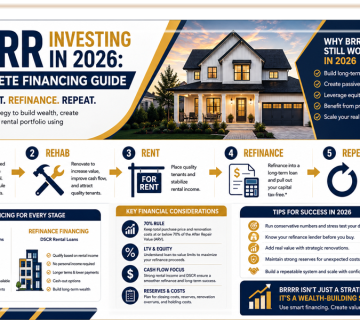
DSCR Loans and the BRRRR Strategy
DSCR loans can also play an important role in a BRRRR strategy:
Buy → Rehab → Rent → Refinance → Repeat
An investor may initially use short-term financing to acquire and renovate a property.
Once the property is renovated and stabilized, the investor may refinance into a long-term DSCR rental loan.
The goal is to convert the stabilized investment into long-term financing while potentially recovering capital that can be redeployed into another investment.
Of course, the success of the strategy depends on the property’s value, rent, financing terms, transaction costs, equity position, and market conditions.
What Investors Should Prepare Before Applying
A smoother DSCR loan process starts before the application.
Have the following information ready:
Property Information
- Property address
- Purchase price
- Property type
- Current occupancy
- Expected rental income
- Existing lease, if applicable
- Property taxes
- Insurance
- HOA information, if applicable
Borrower Information
- Credit profile
- Investment experience
- Available liquidity
- Real estate owned
- Existing mortgages
- Entity information, if applicable
Transaction Information
- Purchase or refinance
- Requested loan amount
- Estimated property value
- Cash-out amount, if applicable
- Intended use of funds
- Expected closing timeline
The more accurately the transaction is presented at the beginning, the easier it is to determine whether the financing structure fits.

DSCR Loans vs. Conventional Loans: The Bottom Line
For real estate investors, the question isn’t simply:
“Which loan is better?”
The better question is:
“Which loan structure best fits the investment?”
A conventional loan may be an excellent solution for an investor with strong documented personal income and conventional eligibility.
A DSCR loan may be a better fit for an investor who wants to qualify primarily through the property’s rental income and avoid relying on traditional personal-income documentation.
That’s why DSCR financing has become such an important tool for today’s real estate investors.
At JCREIG Capital Funding, our investor-focused DSCR financing is designed around the economics of rental properties rather than requiring investors to fit every deal into a traditional income model.
Our marketed DSCR program offers up to 80% LTV on purchases and up to 75% LTV on cash-out refinances, with qualification based on rental income rather than personal income, subject to program guidelines.
Ready to See If Your Rental Property Qualifies?
Whether you’re purchasing your first investment property or expanding an existing portfolio, the right financing structure can make a significant difference.
Don’t let complicated personal income documentation stop you from pursuing a strong investment property.
Explore your DSCR financing options with JCREIG Capital Funding and find out whether the property’s rental income can support the loan.
JCREIG Capital Funding
Investor-Focused Financing for Real Estate Investors
Phone: (561) 303-0334
Email: info@jcreigcapitalfunding.com
FAQs
A DSCR loan primarily evaluates the investment property’s rental income and ability to cover its debt obligations, while a conventional loan generally places greater emphasis on the borrower’s personal income, debts, credit, and overall financial profile.
Yes, many DSCR loan programs do not require personal tax returns for qualification. Instead, the lender may qualify the borrower based primarily on the property’s rental income and other program requirements. Documentation requirements vary by lender.
A DSCR loan typically uses the property’s qualifying rental income compared with the property’s debt obligations. A simplified calculation is:
DSCR = Qualifying Rental Income ÷ Monthly Debt Service
The higher the ratio, the stronger the property’s ability to support the proposed loan.
The minimum DSCR varies by lender and loan program. Some investor programs may allow qualification at a DSCR below 1.00, while other programs require the property to generate enough income to fully cover its debt obligations or more.
Yes. DSCR loans are specifically designed for qualifying investment properties. They can be used for eligible rental-property purchases, subject to the lender’s property, borrower, credit, LTV, and underwriting requirements.
Many investor-focused DSCR programs allow eligible properties to be held in an LLC or other business entity. Entity requirements vary by lender, so investors should confirm the ownership structure before closing.
Not necessarily. One of the major advantages of many DSCR programs is that qualification can be based primarily on the property’s rental income rather than traditional employment income. Other borrower documentation and eligibility requirements may still apply.
Not necessarily. The better option depends on the investor’s financial profile and investment strategy. DSCR loans can be particularly attractive for investors who have strong rental properties but don’t want to rely heavily on personal income documentation. Conventional loans may be more attractive for borrowers who have strong documented income and qualify for favorable conventional terms.
The maximum loan amount depends on the lender, property type, location, credit profile, DSCR, LTV, and other factors. Some DSCR programs offer relatively high leverage, but the exact maximum must be determined based on the specific transaction.
Yes. DSCR loans may be available for eligible rate-and-term and cash-out refinance transactions. For example, JCREIG Capital Funding’s investor DSCR program has offered up to 75% LTV on qualifying cash-out refinances, subject to program guidelines and underwriting approval.
SEO tip: Add these FAQs to the article using FAQ schema markup if your website platform supports it. Also, naturally use variations such as “DSCR loans without tax returns,” “DSCR loans for real estate investors,” and “DSCR vs conventional loans” throughout the page rather than repeating the exact focus keyphrase excessively.