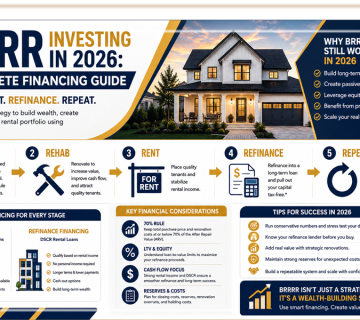



A practical guide to protecting your profit, controlling your renovation budget, and choosing the right financing for your next investment property
Fixing and flipping real estate can be highly profitable—but it is not simply a matter of buying a property cheaply, renovating it, and selling it for more.
The difference between a profitable flip and a losing deal often comes down to a handful of decisions made before the property is purchased.
In today’s market, that discipline matters more than ever. ATTOM reported that 64,348 single-family homes and condos were flipped in the first quarter of 2026, representing approximately 8% of all U.S. home sales. The typical gross return was 25.4%, with a gross profit of approximately $66,000. However, those figures represent the spread between the purchase price and resale price—not the investor’s actual net profit after renovation, financing, holding, and selling expenses.
The message for today’s investor is simple:
A deal that looks profitable on paper can become a bad deal very quickly when the numbers, timeline, or financing are wrong.
Below are 10 of the most costly mistakes fix-and-flip investors make—and what you can do to avoid them.
1. Overpaying for the Property
One of the most expensive mistakes happens before the renovation even begins: paying too much for the property.
Investors sometimes become emotionally attached to a deal because they believe the property has tremendous potential. They see the finished house in their mind and convince themselves that the numbers will work.
But potential does not pay the mortgage.
The purchase price must be supported by the property’s expected resale value, renovation budget, financing costs, holding costs, and selling expenses.
Why overpaying is so dangerous
Suppose an investor estimates:
- Purchase price: $250,000
- Renovation: $60,000
- ARV: $400,000
At first glance, there appears to be a $90,000 spread.
But that $90,000 is not profit.
The investor still needs to account for:
- Loan interest
- Origination or lender fees
- Property taxes
- Insurance
- Utilities
- Permits
- Contractor costs
- Landscaping
- Realtor commissions
- Seller closing costs
- Title and settlement expenses
- Unexpected repairs
- Extended holding time
A seemingly attractive $90,000 spread can shrink dramatically.
How to avoid it
Establish your maximum purchase price before making the offer.
Analyze the property backward:
Expected resale price − selling costs − renovation − financing − holding costs − desired profit = maximum acquisition price
Never allow the seller’s asking price to determine whether the deal works.
Your numbers should determine your offer—not the other way around.
2. Using an Unrealistic ARV
The After Repair Value (ARV) is one of the most important numbers in a fix-and-flip transaction.
It is also one of the easiest numbers to get wrong.
Investors sometimes select the highest-priced property in the neighborhood and use that sale as their comparable—even when the property is substantially different in size, condition, location, layout, or quality.
That can create an artificially high ARV.
What happens when ARV is overstated?
An inflated ARV can cause an investor to:
- Pay too much for the property
- Overspend on renovations
- Borrow more than the project can comfortably support
- Underestimate the required equity
- Overestimate expected profit
- Have difficulty selling the property at the projected price
Current market data reinforces the importance of evaluating each deal locally. ATTOM’s Q1 2026 data showed significant differences in flipping profitability from one metro market to another.
How to analyze ARV correctly
Look for comparable properties that are:
- Recently sold
- Close to the subject property
- Similar in square footage
- Similar in bedroom and bathroom count
- Similar in lot size
- Similar in construction style
- Similar in neighborhood quality
- Similar in finished condition
Do not simply ask:
“What is the most expensive house nearby?”
Ask:
“What would a realistic buyer pay for this exact property after the planned renovation?”
That is a much more useful ARV question.
3. Underestimating the Renovation Budget
This is one of the most common ways a profitable flip turns into a financial problem.
An investor may walk through a property and estimate:
“The rehab should cost around $50,000.”
Then the contractor starts opening walls.
Suddenly there is:
- Electrical work
- Plumbing replacement
- Roof damage
- Structural deterioration
- Mold
- HVAC issues
- Foundation concerns
- Code violations
- Permit requirements
- Water damage
- Sewer problems
The $50,000 renovation can quickly become a $75,000 or $90,000 project.
Build a detailed scope of work
Before closing, identify as many renovation costs as possible.
Break the budget into categories such as:
Exterior
- Roof
- Siding
- Windows
- Doors
- Landscaping
- Driveway
- Exterior paint
Interior
- Flooring
- Drywall
- Paint
- Kitchen
- Bathrooms
- Doors and trim
- Lighting
Systems
- HVAC
- Electrical
- Plumbing
- Water heater
Professional and municipal costs
- Architectural plans
- Engineering
- Permits
- Inspections
- Dumpster
- Labor
- Materials
And don’t forget the contingency.
Build a contingency into the budget
A renovation budget without a contingency is not a complete budget.
The amount will vary depending on the property and scope, but investors should have a realistic reserve for unexpected costs.
The objective is not to predict every problem.
It is to make sure one unexpected problem does not destroy the entire deal.
4. Ignoring Holding Costs
Many new investors focus heavily on acquisition and renovation costs while overlooking the cost of simply owning the property every month.
That can be a major mistake.
Your property may generate no income while it is being renovated.
Yet the bills continue.
Holding costs can include:
- Loan interest
- Property taxes
- Insurance
- Utilities
- HOA fees
- Lawn maintenance
- Security
- Dumpster costs
- Property management
- Temporary repairs
- Financing extension fees
For example, if your total monthly carrying cost is $4,000 and your project takes three months longer than expected, that delay can add $12,000 to the project.
That comes directly out of your profit.
The lesson
Don’t budget only for the best-case timeline.
Model your deal at:
On-time completion
30-day delay
60-day delay
90-day delay
If the project stops making sense after a modest delay, the deal may be too thin.
5. Underestimating the Importance of the Contractor
A great acquisition can still become a bad investment if the contractor cannot execute the project properly.
Contractor problems can cause:
- Cost overruns
- Missed deadlines
- Poor workmanship
- Material delays
- Failed inspections
- Permit problems
- Subcontractor disputes
- Rework
- Legal issues
- Extended loan costs
Don’t select a contractor solely because they are the cheapest.
The cheapest bid is not necessarily the cheapest project.
A contractor who is $10,000 cheaper but takes three additional months could ultimately cost you much more.
Before hiring a contractor
Consider checking:
- References
- Previous projects
- Licensing requirements
- Insurance
- Contractor experience
- Subcontractors
- Written scope of work
- Payment schedule
- Estimated completion date
- Change-order procedures
A professional scope of work should clearly define what is being completed and what is excluded.
6. Choosing the Wrong Financing
Financing is not just a source of money.
It is part of the deal structure.
Using the wrong loan can create unnecessary costs, delays, or cash-flow problems.
Traditional financing may not be appropriate for a property requiring significant renovation, while a short-term investor loan can be structured specifically around the acquisition and rehabilitation of an investment property.
Fix-and-flip financing may provide features such as:
- Short-term financing
- Acquisition funding
- Rehab financing
- Interest-only structures
- Asset-based underwriting
- Financing based partly on the property’s projected value
- Rehab funds released through draws
But investors should carefully evaluate the entire loan structure, not simply the interest rate.
Compare more than the rate
When reviewing a fix-and-flip loan, look at:
- Interest rate
- Loan-to-cost (LTC)
- Loan-to-value (LTV)
- ARV limitations
- Rehab financing
- Draw process
- Draw inspection requirements
- Origination fees
- Points
- Minimum interest
- Extension terms
- Prepayment provisions
- Closing costs
- Required reserves
- Closing timeline
A slightly higher rate may be acceptable if the financing structure allows you to acquire and renovate the property efficiently.
Conversely, a lower rate does not automatically mean a better loan.
The right question is:
“Which financing structure produces the best overall result for this specific project?”
7. Not Understanding Rehab Draws
When a lender finances renovation costs, the rehab funds are often not handed to the investor as one large lump sum.
Instead, funds may be released through draws as construction milestones are completed.
This is important because contractors still need to be paid while the project is underway.
A common problem
An investor agrees to a contractor’s payment schedule without first understanding the lender’s draw schedule.
The contractor expects $25,000.
The lender’s next draw is only $15,000.
Now the investor has to come up with the difference.
This can create unnecessary cash-flow pressure.
Avoid the problem
Before closing, understand:
- How draws work
- When inspections occur
- What documentation is required
- How quickly draws are processed
- Whether there are minimum draw amounts
- Whether the lender requires paid invoices
- How completed work is verified
- Whether the lender reimburses or advances funds
Your contractor and lender should be operating from the same project timeline.
8. Failing to Have a Backup Exit Strategy
Every investor should know how they plan to get out of the deal.
The obvious exit strategy for a flip is:
Renovate → List → Sell → Pay off the loan → Collect the remaining profit
But what happens if the property doesn’t sell?
What if the market changes?
What if the buyer’s financing falls through?
What if the property takes 90 days longer to sell?
What if the investor decides to keep it as a rental?
A strong investor thinks about the backup exit before closing.
Possible exit strategies
Depending on the property and borrower’s objectives, alternatives may include:
- Retail sale
- Sale to another investor
- Rental conversion
- DSCR refinance
- Long-term hold
- Seller financing, where appropriate
- Alternative disposition strategy
This is one reason the BRRRR strategy can be attractive for certain investors.
An investor may initially acquire and renovate the property using short-term financing, then refinance into longer-term rental financing after stabilization if the property and borrower qualify.
9. Spending Too Much on the Renovation
Not every renovation increases the property’s value dollar-for-dollar.
An investor can easily spend $50,000 improving a property and discover that the market only recognizes $25,000 of that improvement.
This happens when renovations exceed what buyers in that neighborhood actually expect.
Common examples
Installing:
- Luxury appliances in a modest neighborhood
- High-end flooring where mid-range flooring is appropriate
- Custom cabinetry
- Excessive landscaping
- Unnecessary structural changes
- Features that don’t match comparable homes
The objective of a flip is not to create the nicest house imaginable.
It is to create a property that is:
Attractive + Functional + Marketable + Appropriate for the neighborhood
Know your buyer
Before selecting finishes, ask:
Who is most likely to buy this property?
Then renovate for that buyer.
A $400,000 house in one neighborhood may need very different finishes than a $400,000 house in another neighborhood.
10. Failing to Have Enough Cash Reserves
Even experienced investors encounter surprises.
A contractor can discover hidden damage.
A permit can take longer than expected.
A buyer can delay closing.
An appraisal can come in below expectations.
The property can sit on the market longer than anticipated.
The solution is not simply to hope everything goes according to plan.
It is to maintain adequate liquidity.
Your reserve should account for potential surprises
Depending on the project, consider having funds available for:
- Unexpected repairs
- Cost overruns
- Additional interest
- Taxes and insurance
- Additional utilities
- Marketing expenses
- Contractor changes
- Closing delays
- Loan extensions
- Appraisal issues
- Reduced sale price
A lack of liquidity can force an investor to make poor decisions at exactly the wrong time.
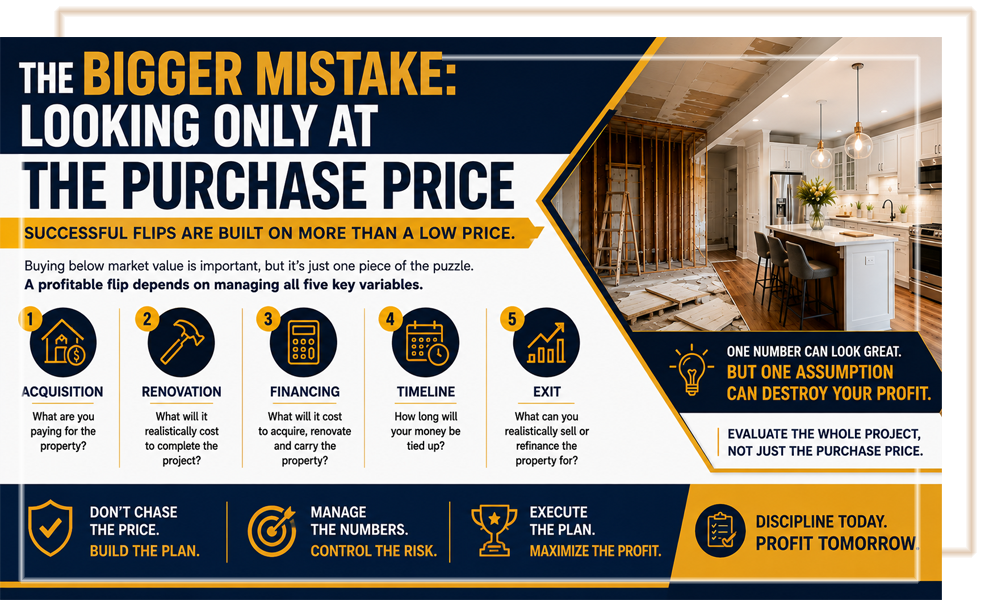
The Bigger Mistake: Looking Only at the Purchase Price
One of the biggest misconceptions in fix-and-flip investing is believing that the primary objective is simply to buy as cheaply as possible.
Buying below market value is important.
But it is only one part of the equation.
A successful flip requires the investor to manage five major variables:
1. Acquisition
What are you paying for the property?
2. Renovation
What will it realistically cost to complete the project?
3. Financing
What will it cost to acquire, renovate, and carry the property?
4. Timeline
How long will your money be tied up?
5. Exit
What can you realistically sell or refinance the property for?
When these five components work together, a deal can become highly attractive.
When even one is significantly wrong, the projected profit can disappear.
A Simple Fix & Flip Deal Analysis
Before purchasing, create a complete project budget.
For example:
| Project Item | Example |
|---|---|
| Purchase Price | $225,000 |
| Estimated Rehab | $65,000 |
| Financing Costs | $20,000 |
| Holding Costs | $15,000 |
| Selling Costs | $25,000 |
| Contingency | $10,000 |
| Total Project Cost | $360,000 |
| Estimated ARV | $425,000 |
| Estimated Net Profit | $65,000 |
The numbers above are for illustration only.
The important point is that the investor should evaluate the entire project, not just:
“Buy for $225,000 and sell for $425,000.”
That $200,000 difference is not your profit.
Everything between acquisition and sale must be accounted for.
Don’t Confuse Gross Profit With Net Profit
This distinction is extremely important.
ATTOM reported a typical gross profit of approximately $66,000 on a flipped property in Q1 2026. But ATTOM specifically notes that its gross-profit calculation is based on the difference between the purchase and resale prices and does not include renovation and other expenses incurred by the investor.
Therefore:
Gross Profit ≠ Net Profit
A more useful calculation is:
Net Profit = Sale Price − Purchase Price − Rehab − Financing − Holding − Selling − Other Project Costs
That is the number investors should focus on.
How Financing Can Affect Your Flip
Consider two investors who purchase similar properties.
Investor A
- Purchases quickly
- Has an appropriate rehab loan
- Understands draw procedures
- Has sufficient reserves
- Completes the project in five months
- Sells quickly
Investor B
- Takes longer to secure financing
- Has insufficient rehab funds
- Experiences draw delays
- Runs out of cash
- Takes eight months to finish
- Needs an extension
Even if both investors purchased similar properties for similar prices, their final profits can be dramatically different.
This is why financing should be considered before you make the offer, not after you have the property under contract.
10-Mistake Fix & Flip Checklist
Before closing on your next project, ask yourself:
- Have I verified the ARV using realistic comparable sales?
- Have I completed a detailed renovation budget?
- Have I included a contingency?
- Have I calculated financing costs?
- Have I calculated monthly holding costs?
- Have I estimated realistic selling costs?
- Have I vetted the contractor?
- Do I understand the lender’s rehab draw process?
- Do I have enough liquidity for unexpected expenses?
- Do I have a backup exit strategy?
- Does the deal still work if the project takes longer than expected?
- Does the deal still work if the final sale price is lower than projected?
If the answer to several of these questions is “no,” the deal deserves additional analysis before you move forward.
Final Thoughts: Successful Flipping Is About Risk Management
The most successful fix-and-flip investors aren’t necessarily the ones who find the biggest discounts.
They are the investors who consistently make disciplined decisions.
They understand their market.
They accurately estimate renovation costs.
They don’t overestimate ARV.
They control their timeline.
They maintain liquidity.
They understand their financing.
And they have a clear exit strategy.
The 2026 market is rewarding that type of discipline. ATTOM’s latest data shows that flipping returns improved in Q1 2026, but profitability continues to vary dramatically by market and individual deal. In its special Q1 analysis, ATTOM highlighted how purchase prices, resale values, renovation costs, and project timelines can materially change the economics of a flip.
In other words, the goal isn’t to flip more houses.
The goal is to flip the right houses with the right numbers, the right financing, and the right execution plan.
Need Financing for Your Next Fix & Flip?
At JCREIG Capital Funding, we help real estate investors access financing designed around investment properties and renovation projects.
Our nationwide Fix & Flip program may offer:
- Up to 90% LTC
- Up to 100% of rehab costs
- Up to 70% ARV
- No income documentation required
- Loan amounts starting at $100,000
- Fast closings
- Minimal documentation
- No upfront fees on qualifying programs
- Experience requirements may be waived on a case-by-case basis
Whether you’re purchasing your first investment property or you’re an experienced investor working on multiple projects, the financing structure should support your acquisition, renovation, and exit strategy.
Ready to See What Your Deal Could Look Like?
Don’t wait until after you have a property under contract to figure out your financing.
Get your project evaluated early so you can understand your potential financing options before you make your offer.
JCREIG Capital Funding
Direct Private Money & NON-QM Mortgage Loans for Real Estate Investors📞 (561) 303-0334
🌐 www.jcreigcapitalfunding.comMost Lenders Say NO. We Say Let’s Close.
FAQs
One of the biggest mistakes is overpaying for the property. If the acquisition price is too high, even a successful renovation and resale may not produce an adequate profit. Investors should analyze the purchase price, rehab costs, financing, holding costs, selling expenses, and realistic ARV before making an offer.
ARV stands for After Repair Value. It is the estimated market value of a property after the planned renovations have been completed. ARV is commonly used by investors and lenders when evaluating the potential economics and financing of a fix-and-flip project.
ARV is generally estimated by analyzing recently sold comparable properties that are similar in location, size, layout, condition, and features. Investors should avoid relying solely on the highest-priced property in the neighborhood and should consider realistic comparable sales.
There is no universal contingency percentage that works for every project. The appropriate reserve depends on the property’s age, condition, renovation scope, location, and level of uncertainty. A contingency should be included in the project budget so an unexpected repair does not immediately eliminate the investor’s projected profit.
Holding costs are the expenses associated with owning the property while it is being renovated and prepared for sale. They can include loan interest, property taxes, insurance, utilities, HOA fees, lawn maintenance, security, and other property-related expenses.
Every additional month can increase the cost of a project. Extended timelines can result in additional interest, taxes, insurance, utilities, contractor expenses, and other carrying costs. Investors should evaluate what happens to the deal if the project takes 30, 60, or 90 days longer than expected.
Investors should evaluate a contractor’s relevant experience, references, licensing and insurance requirements, previous projects, scope of work, payment schedule, estimated completion time, subcontractors, and change-order procedures. The lowest bid is not necessarily the best choice.
LTC stands for Loan-to-Cost. It measures the loan amount relative to the total project cost. Depending on the lender and program, project costs may include the acquisition price and eligible renovation expenses.
For example, if the total project cost is $300,000 and the loan is $240,000:
$240,000 ÷ $300,000 = 80% LTC
LTC requirements and calculations vary by lender and loan program.
LTV stands for Loan-to-Value. It compares the loan amount to the value of the property. In fix-and-flip financing, lenders may also consider the property’s projected value after renovation, commonly referred to as ARV, subject to program guidelines.
Yes. Some fix-and-flip hard money programs can provide financing for both property acquisition and eligible renovation costs. The exact amount available, draw structure, LTC, ARV limitations, and borrower requirements vary by lender and program.
When a lender finances renovation costs, those funds may be released in stages as work is completed. The lender may require inspections, documentation, invoices, or other evidence that the renovation milestones have been completed.
Investors should understand the lender’s draw process before closing and coordinate the construction schedule with the contractor.
No. Investors should evaluate the entire cost and structure of the loan, not just the interest rate.
Important factors can include:
- Interest rate
- Origination fees
- Points
- LTC
- LTV or ARV limitations
- Rehab financing
- Draw procedures
- Closing costs
- Extension terms
- Minimum interest
- Prepayment provisions
- Required reserves
- Closing speed
A loan with a slightly higher rate may potentially be more useful if its overall structure better fits the project.
A delayed project can increase holding and financing costs and may reduce your final profit. Depending on the circumstances and loan terms, investors may need a loan extension, additional reserves, or another exit strategy.
This is why investors should stress-test the deal before closing.
A backup exit strategy is an alternative plan for disposing of or financing the property if the original plan does not work.
For a fix-and-flip investor, the original plan may be to renovate and sell. Depending on the property and qualification requirements, alternatives could include selling to another investor, refinancing into long-term rental financing, or retaining the property as a rental.
Potentially, yes. Investors who decide to keep a renovated property as a rental may be able to refinance into a DSCR loan if the property, borrower, and loan meet the applicable program requirements.
DSCR financing can be particularly useful for investors who want to qualify based primarily on the property’s rental income rather than traditional personal-income documentation, subject to lender guidelines.
There is no single profit amount that makes every flip worthwhile. The required profit should account for the investor’s risk, capital, financing costs, renovation complexity, timeline, market conditions, and potential downside.
A deal with a $75,000 projected profit may be less attractive than a $50,000 deal if the first project carries substantially more risk.
Gross profit is generally the difference between the acquisition price and resale price.
Net profit accounts for the additional expenses required to complete and sell the project.
A simplified calculation is:
Net Profit = Sale Price − Purchase Price − Rehab − Financing − Holding Costs − Selling Costs − Other Project Expenses
Investors should focus on projected net profit, not simply the difference between purchase price and resale price.
Commonly overlooked expenses can include:
- Loan interest
- Loan fees
- Property taxes
- Insurance
- Utilities
- Permit fees
- Inspection fees
- Dumpster costs
- Landscaping
- HOA fees
- Realtor commissions
- Seller closing costs
- Title expenses
- Loan extension fees
- Unexpected repairs
- Contractor change orders
A complete project budget should account for these expenses before the investor closes.
Not necessarily. Renovations should generally be appropriate for the property’s neighborhood and target buyer.
Over-improving a property can result in spending more money than the market will recognize in the final sale price.
The goal is not necessarily to build the most expensive house in the neighborhood. The goal is to create a property that is competitive with the homes buyers are actually purchasing.
The required amount depends on the financing structure, down payment, renovation costs, reserves, closing expenses, and lender requirements.
Even when a lender finances a significant portion of the project, investors should consider maintaining liquidity for unexpected expenses, draw timing, cost overruns, and extended holding periods.
Yes. Ideally, investors should understand their financing options before submitting an offer.
Knowing your potential loan amount, required equity, rehab financing, estimated costs, and closing timeline can help you determine whether a deal actually works before you commit to the purchase.
Potentially. Requirements vary by lender and program. Some programs place greater emphasis on prior investment experience, while others may consider first-time investors under certain circumstances.
Investors should discuss the specific property, renovation scope, financial profile, and exit strategy with the lender before assuming they will or will not qualify.
There is no universal credit-score requirement. Minimum credit scores and other qualification criteria vary by lender, loan program, property type, loan amount, experience, and overall transaction strength.
A strong deal may be evaluated differently from another project with higher risk.
Depending on the lender and program, fix-and-flip financing may be available for various investment properties, including certain single-family homes, townhomes, condos, and multifamily properties.
Property eligibility varies, so investors should confirm that the specific property qualifies before proceeding.
There is no way to eliminate investment risk, but investors can reduce avoidable risk by:
- Buying at the right price.
- Using realistic comparable sales.
- Accurately estimating the renovation.
- Including a contingency.
- Choosing qualified contractors.
- Understanding financing costs.
- Accounting for holding costs.
- Maintaining adequate reserves.
- Stress-testing the project timeline.
- Having a realistic exit strategy.
The best flips are usually built on conservative numbers—not optimistic assumptions.
Before you put your next investment property under contract, make sure you understand both the deal economics and the financing structure.
JCREIG Capital Funding provides financing solutions for real estate investors, including fix-and-flip, bridge, DSCR, ground-up construction, multifamily, commercial, and other investor loan programs.
Fix & Flip Financing
Depending on the program and transaction, financing may include:
- Up to 90% LTC
- Up to 100% of eligible rehab costs
- Up to 70% ARV
- Loan amounts starting at $100,000
- No income documentation on qualifying programs
- Fast closings
- Minimal documentation
Call JCREIG Capital Funding:
(561) 303-0334
Visit:
www.jcreigcapitalfunding.com
Don’t just find a property. Find a deal that makes sense.