


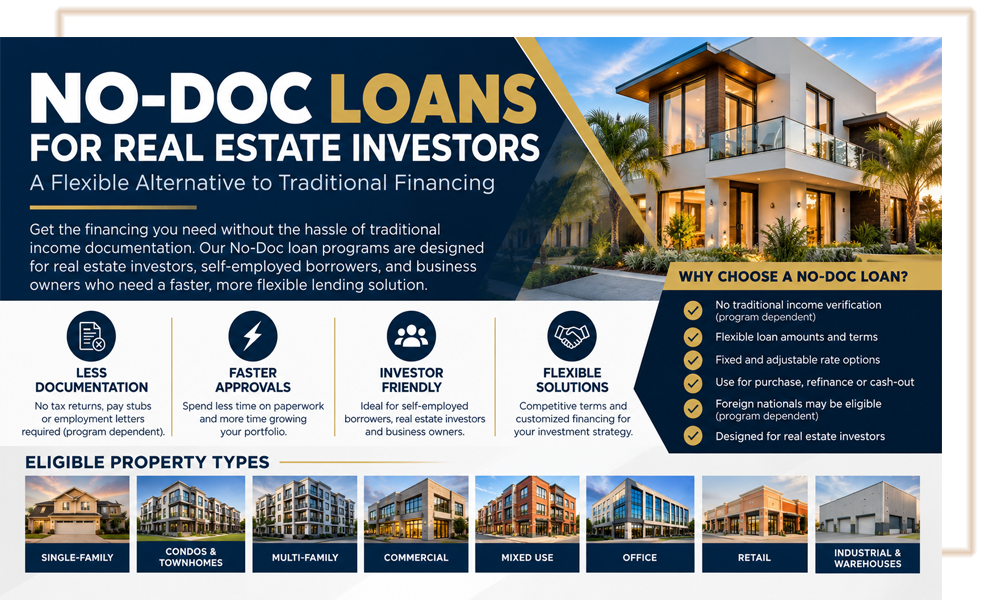
Are traditional mortgage requirements slowing down your next real estate investment? If you’re a real estate investor, self-employed borrower, or property owner whose income doesn’t fit neatly into conventional lending guidelines, a No-Doc loan may offer an alternative financing solution.
Traditional mortgages often require extensive income documentation, including tax returns, pay stubs, and employment verification. For investors who generate income through rental properties, real estate transactions, or business ownership, documenting income under conventional guidelines can be challenging.
No-Doc and other alternative-documentation loan programs may provide greater flexibility by placing more emphasis on the investment property, borrower qualifications, available assets, and the overall strength of the transaction.
At JCREIG Capital Funding, we understand that real estate investors need financing solutions that align with their investment strategies—not unnecessary obstacles that delay opportunities.
What Is a No-Doc Loan?
A No-Doc loan, short for no-documentation loan, is a financing option that generally requires less traditional income documentation than a conventional mortgage. Depending on the lender and loan program, borrowers may not need to provide traditional pay stubs, employment letters, or personal tax returns.
However, no-doc does not necessarily mean no documentation. Lenders may still require information about the property, credit history, assets, investment experience, entity ownership, or the borrower’s ability to repay the loan. Requirements vary depending on the transaction and applicable lending regulations.
Some programs evaluate the property’s value and investment potential, while others may consider rental income, liquidity, creditworthiness, or other qualifying factors.
These financing options can be particularly useful for real estate investors, entrepreneurs, and self-employed borrowers whose financial situations differ from those of traditional W-2 employees.
Top Benefits of No-Doc Loans for Real Estate Investors
For investors seeking an alternative to conventional financing, No-Doc and alternative-documentation loan programs may offer several advantages.
1. Less Traditional Income Documentation
Real estate investors often receive income from multiple sources, including rental properties, property sales, and business ventures. Traditional income verification may not accurately reflect their financial position.
Depending on the program, alternative-documentation financing may reduce the need for conventional income records and provide a more flexible qualification process.
2. Financing Designed for Investment Properties
Many alternative lending programs are structured around real estate investment transactions rather than conventional owner-occupied home purchases.
Depending on lender guidelines, financing may be available for eligible properties such as:
- Single-family investment properties
- Condominiums and townhomes
- Multifamily properties
- Commercial real estate
- Mixed-use properties
- Office and retail properties
- Industrial properties and warehouses
Property eligibility, occupancy requirements, loan size, and available terms vary by program.
3. A Potentially More Efficient Approval Process
Time is often critical in real estate investing. Investors may need to secure financing quickly to compete for properties, fund renovations, or complete time-sensitive transactions.
Some private lending and alternative-documentation programs offer streamlined underwriting and faster closings than conventional financing. Actual timelines depend on the lender, transaction complexity, appraisal, title work, and the completeness of the application.
4. Flexible Financing Structures
Alternative lending programs may offer a variety of loan structures to accommodate different investment strategies. Depending on the program, options may include fixed or adjustable interest rates, different loan terms, and financing tailored to specific property types or transaction purposes.
The right structure depends on your investment goals, projected cash flow, holding period, and exit strategy.
5. Options for Self-Employed and International Investors
Self-employed borrowers and real estate investors may benefit from programs that evaluate financial qualifications differently from conventional mortgage underwriting.
Certain lenders also offer financing to eligible foreign nationals investing in U.S. real estate. Eligibility, documentation requirements, available loan structures, and down payment requirements vary by lender and program.

Why Consider a No-Doc Loan for Your Next Real Estate Investment?
Real estate investing requires flexibility. Whether you’re purchasing an investment property, refinancing an existing asset, or expanding your portfolio, your financing should support your overall investment strategy.
No-Doc and alternative-documentation loans may be worth exploring if you:
- Generate income primarily through real estate investments or business ownership.
- Want to explore financing options that require less traditional income documentation.
- Need financing for an eligible investment property.
- Are considering a cash-out refinance to access equity for business or investment purposes.
- Want to evaluate alternatives to conventional mortgage financing.
- Need a lending solution that aligns with your investment timeline.
Keep in mind that reduced income documentation does not eliminate underwriting requirements. Lenders will evaluate the transaction according to the specific loan program, applicable regulations, and their lending criteria.
What Loan Amounts, Rates, and Terms Are Available?
Loan amounts, interest rates, maximum loan-to-value ratios, and repayment terms depend on the lender and the details of the transaction.
Factors that may influence your financing options include:
- Property type and location
- Property value and requested loan amount
- Credit profile
- Available liquidity and reserves
- Rental income or other qualifying factors, when applicable
- Investment experience
- Loan purpose and proposed exit strategy
Some programs offer fixed-rate or adjustable-rate options, while others are structured around specific investment needs.
Rather than relying on advertised rates or maximum leverage figures alone, investors should compare the complete loan structure, including interest rate, origination fees, closing costs, prepayment provisions, repayment terms, and applicable underwriting requirements.
The best financing option is the one that fits your property, your investment strategy, and your financial objectives.
How Do You Apply for a No-Doc Investment Loan?
Getting started is straightforward. The first step is to discuss your investment goals and determine which financing programs may be appropriate for your transaction.
Step 1: Discuss Your Investment Strategy
Explain whether you’re purchasing, refinancing, renovating, or holding an investment property. Clarifying the purpose of the loan helps identify potentially suitable programs.
Step 2: Provide the Basic Deal Information
Be prepared to share details such as the property address, estimated value, requested loan amount, ownership structure, and intended use of the funds.
Step 3: Review Available Financing Options
A lending professional can help you evaluate potentially suitable programs, including applicable leverage limits, interest rates, fees, documentation requirements, and repayment terms.
Step 4: Complete Underwriting and Due Diligence
Once a suitable program is identified, the lender will outline the documentation and verification required for the transaction. This may include property valuation, title review, credit evaluation, asset verification, and other underwriting requirements.
Step 5: Move Toward Closing
After the lender completes its review and all applicable conditions are satisfied, the transaction can proceed toward closing.
Timelines vary by loan program and transaction complexity, so providing complete and accurate information early can help avoid unnecessary delays.

Find the Right Financing for Your Investment Strategy
You don’t have to let conventional income documentation determine your next move in real estate.
If you’re looking for flexible financing for an investment property, a cash-out refinance, or another real estate transaction, exploring alternative-documentation and private lending options may help you identify a solution that fits your goals.
At JCREIG Capital Funding, we work with real estate investors to explore financing solutions for a range of investment property transactions. Our focus is on understanding the deal, evaluating the available options, and helping investors determine the next steps toward financing.
Ready to Explore Your Financing Options?
Your next real estate opportunity shouldn’t be held back by a one-size-fits-all approach to financing.
Let’s discuss your property, your goals, and the loan options that may be available for your next investment.
Contact JCREIG Capital Funding today to discuss your deal and explore financing options designed for real estate investors.
JCREIG Capital Funding
📞 Call: 866-303-0334
🌐 Get A Quote: jcreigcapitalfunding.com
Frequently Asked Questions About No-Doc Loans
A No-Doc loan is a financing option that generally requires less traditional income documentation than a conventional mortgage. Depending on the loan program, lenders may place greater emphasis on the property, credit profile, available assets, and other qualifying factors.
Some No-Doc and alternative-documentation programs do not require traditional personal tax returns or pay stubs. However, documentation requirements vary by lender and loan type. Borrowers may still need to provide information about their assets, credit, property, or ability to repay the loan.
Potential borrowers may include real estate investors, self-employed individuals, business owners, and other borrowers whose income is difficult to document using conventional methods. Qualification depends on the specific loan program, property, credit profile, financial circumstances, and underwriting requirements.
Yes. Certain No-Doc and alternative-documentation programs are designed for investment properties. Eligible property types may include single-family homes, condominiums, townhomes, multifamily properties, and select commercial or mixed-use properties. Availability depends on the lender’s guidelines.
Potentially. Self-employed borrowers may benefit from programs that do not rely exclusively on traditional employment records or personal tax returns. Depending on the program, lenders may evaluate assets, creditworthiness, property performance, or other financial information.
Some lenders offer real estate financing to eligible foreign nationals investing in U.S. properties. Requirements may differ from those for U.S. citizens and permanent residents and can include additional identification, asset, credit, or down payment documentation.
The available loan amount depends on the property value, loan-to-value ratio, property type, borrower qualifications, loan purpose, and lender guidelines. Maximum loan amounts vary by program, so investors should discuss their specific transaction with a lending professional.
Maximum loan-to-value (LTV) ratios vary by lender and program. The amount available may depend on the property’s value, location, condition, type, and the borrower’s qualifications. Some transactions may require a larger equity contribution or a lower LTV.
No-Doc and alternative-documentation loans may have higher interest rates or fees than some conventional mortgage products because of their different underwriting criteria and risk profiles. Actual pricing depends on the lender, loan structure, property, borrower qualifications, and market conditions.
Some private lending and alternative-documentation loans can close faster than conventional mortgages. However, the timeline depends on the complexity of the transaction, underwriting, appraisal or valuation, title review, required documentation, and other closing conditions. A specific closing date cannot be guaranteed before the lender evaluates the deal.
Certain programs allow eligible borrowers to refinance an existing investment property and access available equity through a cash-out refinance. The amount of cash available depends on the property’s value, outstanding liens, maximum permitted LTV, seasoning requirements, and the lender’s guidelines.
No. Although both may offer alternatives to traditional personal income verification, they are not the same.
A DSCR loan generally evaluates the property’s rental income relative to its debt obligations. A No-Doc loan is a broader term for financing that requires reduced traditional documentation, with qualification criteria depending on the specific program. Some programs may overlap in their documentation requirements, but the terms are not interchangeable.
Some No-Doc and alternative-documentation mortgage programs fall within the non-qualified mortgage (Non-QM) category, but not every loan described as No-Doc is necessarily a Non-QM mortgage. Classification depends on the loan structure, purpose, applicable regulations, and lender guidelines.
Like any financing product, No-Doc loans involve risks. Potential considerations include higher borrowing costs, shorter repayment terms, adjustable interest rates, balloon payments, or other loan-specific conditions. Investors should review the complete loan agreement, understand the repayment obligations, and ensure the financing aligns with their investment strategy.
The first step is to discuss your investment property and financing goals with JCREIG Capital Funding. Be prepared to provide basic information about the property, requested loan amount, loan purpose, ownership structure, and your investment strategy. We can help you explore potentially suitable financing options and explain the applicable requirements.
Ready to explore financing for your next investment?
Contact JCREIG Capital Funding to discuss your deal and learn about available financing options for real estate investors.
Call: 866-303-0334
Website: jcreigcapitalfunding.com
Loan programs, terms, rates, eligibility, and documentation requirements vary. All financing is subject to applicable underwriting criteria, program availability, and lending requirements.
All financing is subject to program availability, underwriting, property eligibility, and applicable lending requirements.
No loan approval, rate, loan amount, or closing timeline is guaranteed.